
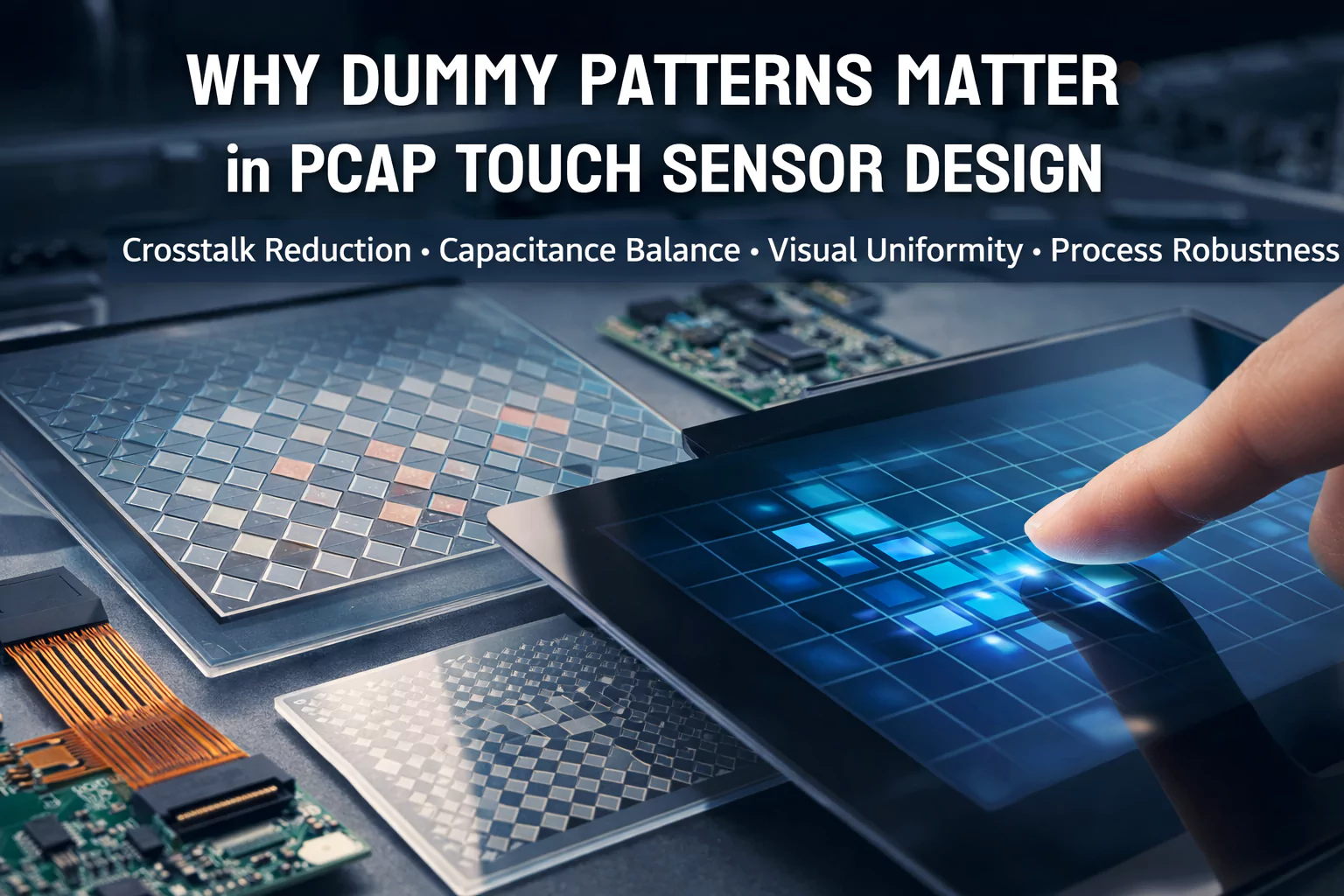
PCAP Sensor Design • ITO Pattern Optimization • Engineering GuideWhy Dummy Patterns Matter in PCAP Touch Sensor Design
In industrial control, automotive interfaces, medical devices, and other high-reliability touch applications, dummy pattern design can play an important role in PCAP sensor optimization. When used correctly in diamond ITO pattern layouts, dummy structures can help improve electric field balance, reduce visible pattern artifacts, support more stable capacitance distribution, and improve manufacturability.
PCAP sensor design
Diamond ITO pattern
Crosstalk reduction
Capacitance balance
Visual uniformity What Is a Dummy Pattern in PCAP Touch Sensor Design?
In projected capacitive touch sensor design, a dummy pattern is an intentionally added conductive structure that does not serve as the main sensing node, but helps optimize the electrical, optical, or process behavior of the sensor layout.
The purpose of a dummy pattern is not simply to fill empty space. Its real value is in helping the design team manage the trade-off between touch performance, pattern visibility, electrical stability, and manufacturability.
Key point: dummy pattern design is a tuning variable, not a universal fix.Typical Application Scenarios
Industrial Control Panels
Industrial HMI systems require stable touch response, strong anti-interference capability, and good long-term consistency.
Automotive Displays
Vehicle interfaces face EMI, temperature variation, and strict visual requirements.
Medical Interfaces
Medical operation panels often require higher signal quality and lower visual distraction.
High-Resolution Display Modules
In OLED or high-PPI display projects, visible ITO pattern artifacts can become more noticeable.
Why Dummy Patterns Are Used
1. Reduce Electrical Crosstalk
Dummy structures can help improve local electric field balance and reduce unwanted coupling behavior in certain layouts.
2. Improve Capacitance Distribution Balance
They can help reduce large local variation in parasitic loading or mutual capacitance behavior across the panel.
3. Improve Visual Uniformity
Dummy structures can help smooth the transition between patterned and non-patterned regions and reduce local pattern visibility.
4. Support Better Process Robustness
A better-balanced layout may help reduce edge stress concentration and improve manufacturability.
Important: dummy pattern design should always be evaluated as part of the full sensor system.Common Design Risks and Pitfalls
Excess Parasitic Capacitance
Too much dummy area can reduce sensitivity instead of improving it.
Visible Pattern Residue
Pattern visibility may remain under side light if optical matching is not optimized.
Registration Error
Poor process alignment can shift dummy regions away from their intended location.
High-Frequency Noise Pickup
Floating dummy structures can behave like antennas in noisy environments.
Edge Detection Disturbance
Aggressive edge dummy design can affect touch boundary recognition.
Overgeneralized Layout Reuse
A dummy strategy that works in one project may not transfer directly to another.
Engineering warning: the goal is not maximum filling, but an optimized balance between capacitance behavior, visual appearance, and process capability.Why Dummy Design Must Be Balanced, Not Maximized
Design Factor Why It Matters Pattern size and density Directly affects parasitic loading, visual blending, and controller signal margin Center vs edge layout Edge regions usually need more conservative treatment than the center sensing area Floating vs grounded strategy Noise behavior can change significantly depending on grounding strategy Optical stack matching ITO visibility depends on pattern design and stack interaction together Manufacturing registration capability Fine dummy layouts are only useful if the process can hold them consistently in production
Engineering Takeaways
Dummy patterns can be an effective design tool in PCAP sensor development, especially when the project must balance touch accuracy, anti-interference performance, visual appearance, and production stability.
A better engineering approach is to treat dummy design as part of the full sensor optimization process, together with controller strategy, stack-up, manufacturing registration, and environment validation.
Final takeaway: good dummy design is not about adding more pattern area. It is about achieving a better overall balance between electrical behavior, optical uniformity, and manufacturability.FAQ
What is the main purpose of a dummy pattern in a PCAP touch sensor?
A dummy pattern helps optimize the balance between electrical behavior, visual uniformity, and manufacturability.
Can dummy patterns reduce crosstalk in touch sensors?
In some layouts, yes. But the result depends on the full pattern and system design.
Do dummy patterns always improve touch performance?
No. If dummy structures are too large, too dense, or poorly positioned, they can reduce touch sensitivity.
Why can dummy patterns affect visual appearance?
The difference between patterned and non-patterned areas can affect light behavior and pattern visibility.
Should dummy patterns in edge areas be designed the same way as the center area?
Usually no. Edge regions often need more careful treatment.
Need help optimizing a PCAP sensor pattern?
If your project needs better touch stability, lower pattern visibility, or a more manufacturable sensor layout, our engineering team can help review the pattern structure and recommend a suitable design path.
Why Dummy Patterns Matter in PCAP Touch Sensor Design
In industrial control, automotive interfaces, medical devices, and other high-reliability touch applications, dummy pattern design can play an important role in PCAP sensor optimization. When used correctly in diamond ITO pattern layouts, dummy structures can help improve electric field balance, reduce visible pattern artifacts, support more stable capacitance distribution, and improve manufacturability.
What Is a Dummy Pattern in PCAP Touch Sensor Design?
In projected capacitive touch sensor design, a dummy pattern is an intentionally added conductive structure that does not serve as the main sensing node, but helps optimize the electrical, optical, or process behavior of the sensor layout.
The purpose of a dummy pattern is not simply to fill empty space. Its real value is in helping the design team manage the trade-off between touch performance, pattern visibility, electrical stability, and manufacturability.
Typical Application Scenarios
Industrial Control Panels
Industrial HMI systems require stable touch response, strong anti-interference capability, and good long-term consistency.
Automotive Displays
Vehicle interfaces face EMI, temperature variation, and strict visual requirements.
Medical Interfaces
Medical operation panels often require higher signal quality and lower visual distraction.
High-Resolution Display Modules
In OLED or high-PPI display projects, visible ITO pattern artifacts can become more noticeable.
Why Dummy Patterns Are Used
1. Reduce Electrical Crosstalk
Dummy structures can help improve local electric field balance and reduce unwanted coupling behavior in certain layouts.
2. Improve Capacitance Distribution Balance
They can help reduce large local variation in parasitic loading or mutual capacitance behavior across the panel.
3. Improve Visual Uniformity
Dummy structures can help smooth the transition between patterned and non-patterned regions and reduce local pattern visibility.
4. Support Better Process Robustness
A better-balanced layout may help reduce edge stress concentration and improve manufacturability.
Common Design Risks and Pitfalls
Excess Parasitic Capacitance
Too much dummy area can reduce sensitivity instead of improving it.
Visible Pattern Residue
Pattern visibility may remain under side light if optical matching is not optimized.
Registration Error
Poor process alignment can shift dummy regions away from their intended location.
High-Frequency Noise Pickup
Floating dummy structures can behave like antennas in noisy environments.
Edge Detection Disturbance
Aggressive edge dummy design can affect touch boundary recognition.
Overgeneralized Layout Reuse
A dummy strategy that works in one project may not transfer directly to another.
Why Dummy Design Must Be Balanced, Not Maximized
| Design Factor | Why It Matters |
|---|---|
| Pattern size and density | Directly affects parasitic loading, visual blending, and controller signal margin |
| Center vs edge layout | Edge regions usually need more conservative treatment than the center sensing area |
| Floating vs grounded strategy | Noise behavior can change significantly depending on grounding strategy |
| Optical stack matching | ITO visibility depends on pattern design and stack interaction together |
| Manufacturing registration capability | Fine dummy layouts are only useful if the process can hold them consistently in production |
Engineering Takeaways
Dummy patterns can be an effective design tool in PCAP sensor development, especially when the project must balance touch accuracy, anti-interference performance, visual appearance, and production stability.
A better engineering approach is to treat dummy design as part of the full sensor optimization process, together with controller strategy, stack-up, manufacturing registration, and environment validation.
FAQ
What is the main purpose of a dummy pattern in a PCAP touch sensor?
Can dummy patterns reduce crosstalk in touch sensors?
Do dummy patterns always improve touch performance?
Why can dummy patterns affect visual appearance?
Should dummy patterns in edge areas be designed the same way as the center area?
Need help optimizing a PCAP sensor pattern?
If your project needs better touch stability, lower pattern visibility, or a more manufacturable sensor layout, our engineering team can help review the pattern structure and recommend a suitable design path.