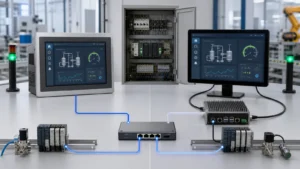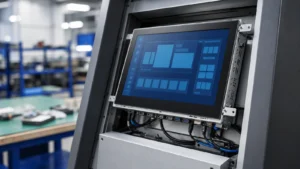
Choosing a rugged industrial touch screen monitor is very different from choosing a commercial display for an office, store, or meeting room. In factories, outdoor terminals, cold storage rooms, EV charging stations, steel workshops, and equipment cabinets, the screen is not only a display. It is the main human-machine interface that operators rely on every day.
If you are shortlisting the best industrial touch screen monitor for a rugged OEM system, compare installation method, brightness, IP rating, touch tuning, and long-term supply before RFQ.
If the monitor cannot start in low temperature, drifts in high temperature, reacts badly to gloves, flickers near motors, or fails after moisture enters the front panel, the whole machine may stop working. That means downtime, maintenance cost, and a poor user experience in the field.
This guide explains the key specifications buyers should check before selecting an industrial touch monitor for harsh environments.
What Makes an Industrial Touch Screen Monitor Rugged?
A rugged industrial touch screen monitor is designed to keep touch performance, display visibility, and system stability under environmental stress. The most important difference is not one single component. It is the full design combination: touch sensor, cover glass, LCD, bonding material, housing, sealing, power design, grounding, and testing.
For harsh environments, buyers should look beyond size and resolution. The real selection questions are:
- Can the screen operate in high and low temperature?
- Can it resist water, moisture, dust, and condensation?
- Can operators use it with gloves or wet hands?
- Can the touch controller remain stable near motors, inverters, and power equipment?
- Can the front panel meet the required IP rating?
- Can the product pass EMC, ESD, vibration, aging, and temperature validation?
If these details are ignored, a monitor that looks acceptable during sample testing may fail after real installation.
1. Temperature Range: Do Not Only Check the Storage Temperature
Temperature is one of the most common failure points for industrial displays. Outdoor kiosks and EV chargers may face freezing winters. Steel plants, machine rooms, and enclosed control cabinets may create long-term high temperature exposure.
A reliable rugged industrial touch screen monitor should clearly state both:
- Operating temperature: the range where the screen can run and respond normally.
- Storage temperature: the range where the screen can be stored or transported while powered off.
These two numbers are not the same. Some products can be stored at a low temperature but cannot operate or respond accurately at that temperature.
For demanding applications, common industrial targets include:
- Standard industrial environment: about -10 C to 60 C
- Wider industrial environment: about -20 C to 70 C
- Harsh outdoor or high-temperature environment: about -30 C to 85 C
- Customized extreme environment: may require -40 C startup design or additional heating
In low temperature, LCD response may become slow, bonding materials may become stressed, cables may become stiff, and the touch controller may become unstable. In high temperature, the display may lose brightness, touch coordinates may drift, adhesives may age faster, and internal electronics may shorten their service life.
For cold regions, ask whether the monitor needs a heating film, low-temperature startup strategy, or wide-temperature controller. For high-temperature environments, ask about thermal design, metal housing, LCD derating, bonding material, and aging test data.
2. IP Rating and Front Panel Sealing
Many industrial monitors are installed in areas with dust, water mist, oil, cleaning liquid, or outdoor rain exposure. In these cases, the front panel protection level is critical.
For many industrial and self-service applications, IP65 front panel protection is a common requirement. It helps protect against dust and low-pressure water spray from the front side. For more demanding applications, higher protection or full enclosure sealing may be needed.
When checking IP protection, confirm these details:
- Is the rating for the front panel only or for the whole monitor?
- Are the connectors protected after installation?
- Is the gasket design suitable for the cabinet or machine cutout?
- Will water collect around the bezel or cable exit?
- Has the product been tested after assembly, not only at component level?
Water and moisture can cause false touch, jumping points, corrosion, fogging, or complete touch failure. Dust can enter gaps, affect infrared or optical structures, damage connectors, or create maintenance problems.
For wet or dusty environments, the monitor should use suitable sealing, stable front glass, industrial touch firmware, and surface treatment such as anti-fingerprint or hydrophobic coating when needed.
3. Glove Touch, Wet Touch, and False Touch Control
In real industrial sites, operators often wear gloves. These may be thin inspection gloves, rubber gloves, waterproof gloves, oil-resistant gloves, or thick winter gloves. A normal capacitive touch screen may not respond well in these conditions.
For a rugged industrial touch screen monitor, glove operation should be considered early in the design stage. Buyers should confirm:
- What glove thickness can be supported?
- Does the screen support wet hand or wet glove operation?
- Can it reject water droplets and avoid false touches?
- Does glove mode need to be enabled manually?
- Is the touch performance stable across the whole active area?
Industrial PCAP touch screens can be tuned for higher sensitivity, but increasing sensitivity without proper filtering can also increase false touches. The better solution is balanced firmware tuning, suitable sensor design, stable grounding, and environmental validation.
For cold storage, food processing, outdoor equipment, and machine tools, glove touch and wet touch performance are often more important than a simple “10-point touch” specification.
4. EMC and ESD: Essential for Factories and Automation Equipment
Industrial environments often contain strong electromagnetic noise. Motors, inverters, welding equipment, power supplies, relays, and control cabinets can all interfere with touch and display signals.
Without proper EMC design, the monitor may show:
- Ghost touches or random touch points
- Touch drift or dead zones
- Display flickering
- USB or serial communication instability
- System freezes or resets
- Failure during customer project acceptance
A reliable industrial touch display should be designed with EMC and ESD protection in mind. Key points include shielded touch signal layout, proper grounding, metal housing, EMI filtering, surge protection, and validated cable routing.
For project buyers, it is not enough to ask whether the product “has anti-interference ability.” Ask for the actual test scope. Important checks may include ESD, radiated emission or immunity, conducted immunity, power disturbance, and system-level grounding recommendations.
ESD is equally important because the touch screen is directly touched by users. Static electricity from hands, gloves, dry air, dust movement, or synthetic materials may create sudden discharge. If the protection is weak, the touch controller IC may freeze, reset, or become permanently damaged.
5. Brightness, Visibility, and Surface Treatment
A rugged industrial touch screen monitor must remain readable in its installation environment. Indoor factories, outdoor kiosks, vehicles, and semi-outdoor terminals have very different brightness needs.
For standard indoor equipment, moderate brightness may be enough. For outdoor or high ambient light use, high brightness LCD, anti-glare cover glass, optical bonding, or anti-reflection treatment may be required.
Useful surface and optical options include:
- AG glass: reduces glare from strong ambient light.
- AR coating: improves transmittance and reduces reflection.
- AF coating: helps reduce fingerprints and surface contamination.
- Optical bonding: improves visibility, reduces internal reflection, increases structural strength, and helps prevent internal fogging.
For outdoor and high-reliability applications, optical bonding can be valuable because air gaps may increase reflection and allow condensation risk. However, it also increases cost, so the decision should be based on the environment, target lifetime, and visibility requirement.
6. Mechanical Structure and Installation Details
Many failures happen not because the touch monitor itself is poor, but because the installation does not match the mechanical environment.
Before confirming a rugged industrial touch screen monitor, check:
- Mounting type: panel mount, open frame, VESA, embedded, wall mount, or custom bracket
- Front bezel and gasket design
- Cable outlet direction and connector clearance
- Vibration and shock exposure
- Housing material and heat dissipation
- Grounding path between monitor and machine frame
- Space for airflow or thermal expansion
For machine tools, vehicles, industrial cabinets, and outdoor terminals, vibration can loosen connectors, damage solder joints, or stress the bonding layer. For high-temperature cabinets, poor airflow can make the monitor run hotter than the ambient rating suggests.
Good mechanical integration should be discussed before mass production, especially for OEM and custom equipment projects.
7. Recommended Specification Checklist
Use this checklist when comparing suppliers:
| Item | What to Confirm | Why It Matters |
|---|---|---|
| Operating temperature | Actual working range, not only storage range | Prevents startup failure, drift, black screen, or slow response |
| IP rating | Front panel or full enclosure rating | Protects against water, dust, and moisture |
| Touch technology | PCAP, resistive, infrared, or custom structure | Affects glove touch, durability, cost, and integration |
| Glove/wet touch | Glove thickness, water rejection, false touch control | Critical for industrial operators |
| EMC/ESD | Test items, grounding, shielding, filtering | Prevents ghost touch, flicker, and system instability |
| Brightness | Indoor, semi-outdoor, or outdoor brightness target | Ensures readability |
| Surface treatment | AG, AR, AF, anti-vandal, antimicrobial, or custom glass | Improves usability and durability |
| Bonding method | Air bonding or optical bonding | Affects visibility, condensation resistance, and strength |
| Interfaces | HDMI, VGA, DP, USB touch, RS232, I2C, LVDS, eDP | Ensures system compatibility |
| Installation | Panel mount, open frame, VESA, custom bracket | Avoids mechanical mismatch |
| Testing | Aging, temperature cycle, vibration, EMC, ESD | Reduces field failure risk |
Common Mistakes When Buying Industrial Touch Monitors
Mistake 1: Choosing by size and price only. Two 15.6-inch monitors may look similar but perform very differently in temperature, moisture, EMC, and glove touch conditions.
Mistake 2: Treating “industrial grade” as a complete specification. Industrial grade should be supported by clear temperature range, protection level, component selection, and test validation.
Mistake 3: Ignoring the installation environment. A product that works on a desk may fail inside a sealed metal cabinet near a motor or inverter.
Mistake 4: Not testing with real gloves, water, and cables. Touch performance should be tested with the same gloves, cable length, controller, power supply, and grounding used in the final system.
Mistake 5: Forgetting maintenance and long-term aging. Harsh environments accelerate aging. Ask about bonding material, coating life, connector protection, and high-temperature aging validation.
Where Ever Glory Rugged Touch Monitors Are Commonly Used
Ever Glory industrial touch screen monitors and touch display solutions are suitable for many harsh or semi-harsh applications, including:
- Industrial automation control panels
- Factory HMI systems
- Outdoor kiosks and EV charging stations
- Cold storage and food processing equipment
- Machine tools and CNC control terminals
- Warehouse and logistics systems
- Medical and laboratory equipment
- Transportation and vehicle-mounted displays
- Self-service terminals and vending machines
For OEM projects, Ever Glory can support custom size, cover glass, touch tuning, bonding, brightness, interface, structure, and environmental design based on the final machine requirements.
FAQ
What is the best touch technology for a rugged industrial touch screen monitor?
PCAP is widely used because it supports a flat front glass design, multi-touch, good durability, and custom tuning for glove or wet touch. Resistive touch may still be useful in some low-cost or special glove applications. The best choice depends on environment, user behavior, and system requirements.
Is IP65 enough for outdoor industrial use?
IP65 front panel protection is often suitable for rain, splash, dust, and front-side exposure after proper installation. However, outdoor equipment also needs connector protection, housing sealing, UV resistance, temperature design, and condensation control.
Can an industrial touch monitor work with thick gloves?
Yes, if the touch sensor, controller firmware, cover glass thickness, and grounding are designed for glove touch. Buyers should test with the actual glove type used in the field.
Why does an industrial touch screen create ghost touches?
Common causes include electromagnetic interference, poor grounding, water on the surface, unstable power supply, long or unshielded touch cables, unsuitable firmware tuning, or low-quality touch controller design.
When should I choose optical bonding?
Optical bonding is recommended when the display needs better outdoor readability, stronger structure, lower internal reflection, better condensation resistance, or higher reliability in vibration and temperature changes.
Conclusion
A rugged industrial touch screen monitor should be selected as a complete reliability system, not just as a screen with a touch panel. Temperature range, IP rating, glove touch, wet touch, EMC, ESD, brightness, bonding, mechanical structure, and validation tests all affect long-term field performance.
For harsh environments, the safest approach is to define the real operating conditions first, then match the monitor design to those conditions. This helps avoid hidden failures, reduces maintenance cost, and gives the final equipment a more stable human-machine interface.
Explore Related Ever Glory Solutions
- Industrial touch screen monitor solutions
- Industrial touch screen monitor for HMI, kiosk and automation
- Industrial automation touch display applications
- IP65 waterproof touch screen monitor
- Sunlight readable touch screen monitor
Need help with a harsh-environment touch display project? Share your size, mounting, brightness, IP rating, glove touch, interface and operating environment requirements with the Ever Glory team for engineering review.
Industrial Touch Monitor Selection: engineering decision summary
Quick answer
Choose an industrial touch monitor when the equipment needs a finished display-and-touch unit without an integrated computer. The key inputs are mounting style, video and touch interfaces, brightness, front protection, service access and the operating environment.
Inputs to confirm
- Panel-mount, open-frame or enclosed installation
- Video input, touch interface and host compatibility
- Brightness, front sealing goal and maintenance access
Evidence boundary
A monitor is not a panel PC and a front-sealing goal is not a universal enclosure rating. Confirm the exact mechanical and environmental boundary in the quotation.
Related engineering guides
- Panel Mount vs Open Frame Touch Screen Monitor Guide
- Medical Touch Screen Monitor Design Guide: EMC, Glove Touch and Cleanability
- Food Processing Touch Screen Monitors for Washdown and Hygienic Environments
- How to make touch screen computer
Project next step: Review the relevant product or solution scope, the validation evidence boundary, and then send the project inputs for engineering review.