.png)
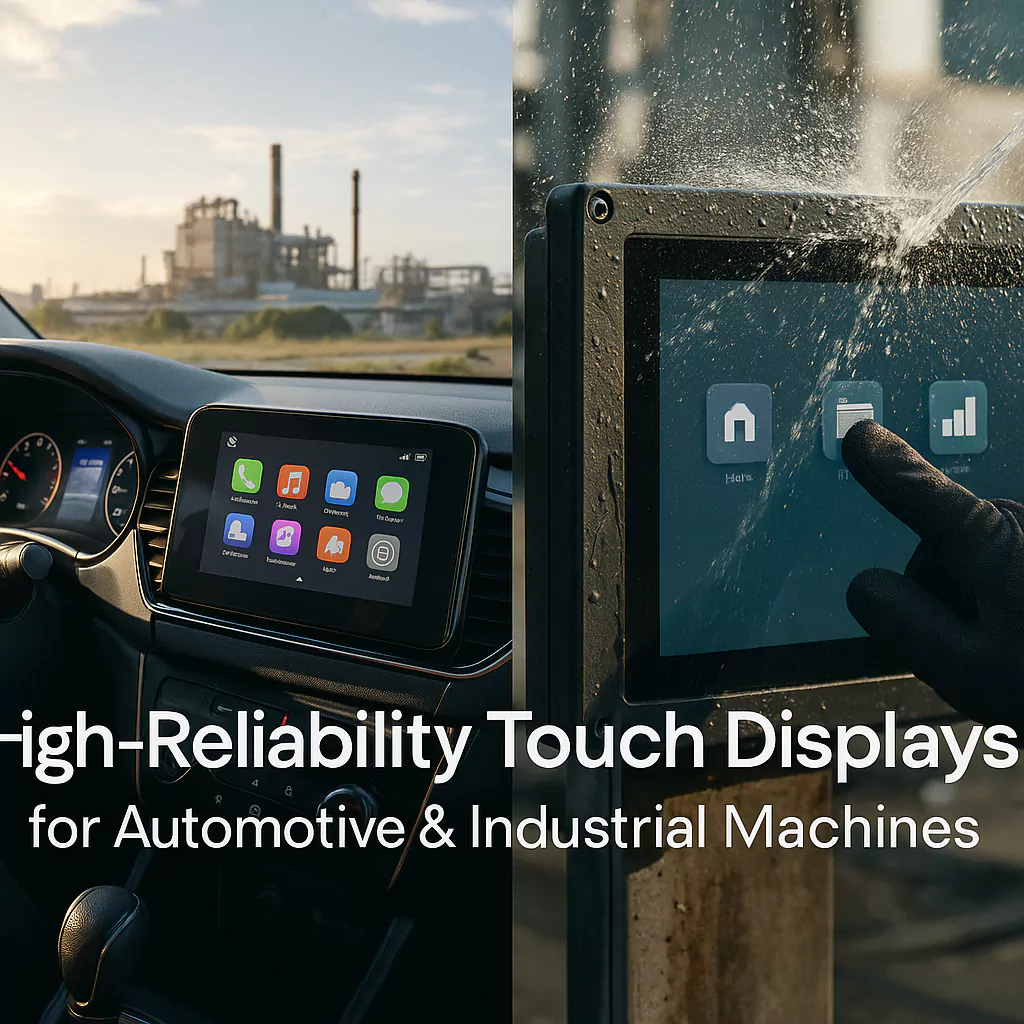
This guide turns real field pain points into buildable solutions. One of the key areas we focus on is high reliability touch display technology, due to its importance in many applications. It links to our core resources:
PCAP touch solutions,
waterproof touch screens,
industrial touch screens,
touch screen HMI applications,
and
industrial touch screen monitor.
Summary
Vehicles and machines run in harsh light, vibration, oil, moisture, and wide temperatures. Displays must stay readable and responsive. The steps below improve contrast, cut glare, raise touch accuracy, and extend service life.
Automotive
Pain points
- Wet or gloved hands reduce touch response.
- Sunlight readability needs ≥1000 cd/m² and low reflectance.
- Wide temperature and thermal shock stress materials.
- Long sun exposure may cause drift and blackening.
- Road vibration can loosen brackets and trigger false touches.
- Glass scratches and smudges build up in daily use.
- Sealing and de-fog are required for safety and comfort.
- Thin and light modules help reduce weight.
Fixes and solutions
Optics & touch
- On-Cell/OGS PCAP to cut stack height and raise SNR.
- Optical bonding with low haze to reduce reflections.
- High-brightness backlight with ALS auto-brightness.
- Surface AF for easy cleaning in daily operation.
Reliability & sealing
- Thin-film heater for anti-fog in cold and wet cabins.
- PCAP firmware tuning with water-drop rejection and glove curves.
- Anti-vibration design: ribs, cushions, anti-loosening fasteners.
- Front-side sealing; see IP65 waterproof touch screens.
Measurable results
- Touch with water and gloves: ≥98% detection; 2–3 mm gloves work.
- Sunlight readability: 30–50% contrast gain at 100k lux; ≤1.5% reflectance.
- Wide-temp stability: –30 to +85 °C; –40/+85 °C 200 cycles passed.
- Durability: 9H hardness; AF reduces residue and speeds cleaning.
- Sealing: IP65 spray without leaks.
Building a custom in-car module? See
automotive touch screen display.
Industrial Machinery (Heavy-Duty HMI)
Pain points
- Portable tools must be lighter.
- High impact and repeated tapping cause damage.
- Pressure changes in sealed housings stress modules.
- Strong vibration and electrical noise trigger false touches.
- Oil, dust, water, and glare reduce readability.
- 24/7 duty needs long life and clear proof.
Fixes and solutions
Structure & materials
- Chemically tempered cover glass (9H, ≥85% transmission) with thin, light design.
- Flexible FPC routing to improve bend life and vibration tolerance.
- Cushion pillars and foams; anti-loosening thread treatments.
- Dual sealing with venting to keep IP65–IP67.
Reliability & certification
- Impact: 0.5–2.0 J steel ball; >107 taps without drift.
- Wide temp/humidity: –20 to +70 °C; 85 °C/85%RH for 168 h; –40/+85 °C shock.
- System validation with on-rig vibration and chamber cycling.
Measurable results
- Weight: 15–25% lighter than standard glass stacks.
- Impact: no cracks at 0.7–2.0 J; >107 actuations OK.
- Anti-vibration: false touches cut by ≥80%; fasteners stay tight after 500 h.
- Readability: ≤1.5% reflectance; high contrast at 50–80k lux.
- Protection: IP65–IP67; oil and dust clean easily. Example:
IP65 waterproof touch panel.
Need a finished monitor? Check our
industrial touch screen monitor
and the pillar page on
industrial touch screens.
Sample spec targets
| Block | Target |
|---|---|
| Luminance | Automotive: 1000–1500 cd/m²; Industrial: 700–1200 cd/m² |
| Reflectance | ≤1.2–1.5% (with optical bonding) |
| Touch | 2–3 mm glove support; water-drop false-touch ≤2% |
| Cover | 9H; 0.7–1.1 mm; edge R0.5–1.0 |
| Protection | Front IP65 (up to IP67) |
| Temperature | Auto: –30 to +85 °C; Industrial: –20 to +70 °C |
| Reliability | –40/+85 °C shock 200 cycles; vibration/shock to profile |
| Lifetime | 24/7 10,000 h no failure; touch >107 actuations |
For application notes, see HMI applications and
PCAP touch solutions.
FAQ
How bright should an outdoor display be?
At least 1000 cd/m². Pair it with bonding to cut reflections and raise contrast.
Can touch work with gloves and water?
Yes. Use PCAP with glove curves and water-drop rejection, then tune thresholds in firmware.
Which tests matter most before mass production?
Luminance and reflectance, ESD/EMC, thermal shock, vibration and shock, IP spray, and touch stability.