.png)
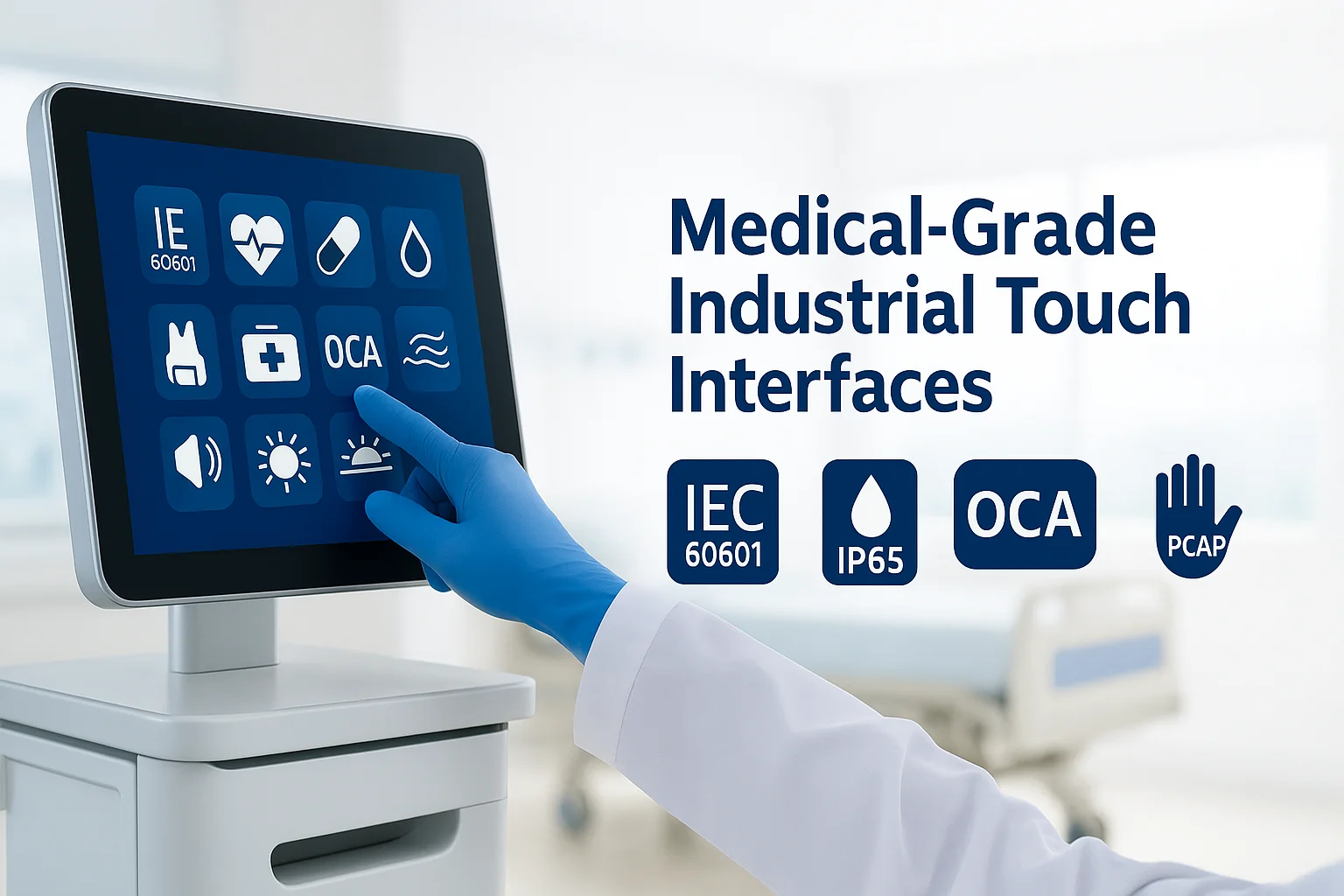
Hospitals demand touch interfaces that are safe, cleanable, and readable. Devices must pass IEC 60601‑1, perform with gloved and wet hands, and resist aggressive disinfection. This white paper turns ten common pain points into a practical design and validation checklist. We outline material choices (G+G cover lens, chemically strengthened glass), optical bonding (OCA full lamination), coatings (AG/AR/AF), sensing algorithms for gloves, EMI/ESD hardening, and compact integration. We also map each decision to measurable outcomes: faster workflows, lower rework, better visibility, and safer operation.
1) Problem Landscape and Design Goals
Related reading: Industrial touch screen basics
| # | Pain Point | Why It Matters |
|---|---|---|
| 1 | Must pass IEC 60601‑1; strict quality control on bubbles/defects | Patient and operator safety; audit readiness |
| 2 | Anti‑glare and anti‑reflection | High‑lux wards and OR lights reduce contrast — see AG/AR coating guide |
| 3 | Poor glove performance | Surgical and nitrile gloves dampen capacitance — PCAP glove tuning |
| 4 | Insufficient display clarity | Small fonts, EHR UI; risk of mis‑read — use OCA bonding |
| 5 | Operator fatigue in long shifts | Low friction AF coatings aid swipe/scroll |
| 6 | Harsh, frequent disinfection | Alcohol, bleach, peroxide degrade surfaces — medical-grade hygiene design |
| 7 | Need bright‑light readability | Ambulance bays, windows — sunlight readable (1000–1500 nits) |
| 8 | False touches / lag | Fluids, mist, EMI cause mis‑trigger — IP65 front design |
| 9 | Strong EMI/ESD environment | Defibrillators, RF — comply with IEC 60601‑1‑2 EMC |
| 10 | Tight, modular integration | Limited space in carts/handhelds; see integration tips |
Design goals: Medical‑grade safety, reliability, and hygiene; high contrast, wide viewing, low reflectance; accurate touch with gloves, saline, and droplets; compact, serviceable integration for OEM enclosures.
2) Standards and Compliance
- IEC 60601‑1: Basic safety and essential performance.
- IEC 60601‑1‑2: EMC; emissions and immunity.
- ISO 13485: Quality management for medical devices.
- Ingress: IP65–IP67 front protection per IEC 60529 for wipe‑down and splash.
- Material safety: RoHS / REACH.
- Usability: IEC 62366‑1 human factors engineering.
Tip: Plan pre‑compliance early. Combine HALT/HASS with EMC pre‑scans to reduce redesign cycles.
3) Hardware Stack: From Cover Lens to Mainboard
Recommended stack
- Cover lens: G+G with chemically strengthened surface, ≥7H scratch resistance.
- Coatings: AG/AR/AF.
- Sensor: PCAP controller with glove modes (≥3 profiles) and water rejection.
- LCD/Panel: High‑brightness backlight; 800–1500 nits per use case; wide‑gamut IPS.
- Bonding: OCA full lamination (gap rate < 0.3%).
- Shielding: ITO shield + grounded bezel; EMI gasket path.
- Power/Signal: Filtered, ESD‑protected lines (TVS diodes), robust FPC routing.
Why this matters: This stack improves contrast, reduces glare, enables reliable touch in gloves and wet conditions, and increases survivability under cleaning.
4) Optical Bonding and Visual Performance
- Total reflectance ≤ 1.5–2.0% (AG+AR + OCA).
- Luminance 800–1500 nits.
- Uniformity ≥ 80%; Mura‑free per visual QA.
- Haze 8–12% (AG) for readability without grain.
Process controls: ISO‑class cleanroom; bubble spec and AQL acceptance; thermal cycling / humidity for bond reliability.
Outcome: Sharper text, fewer reflections under OR lights, and stable readability over life.
5) Touch Performance with Gloves and Fluids
Controller & firmware: Multi‑profile Glove Mode (latex, nitrile, neoprene); water rejection and palm‑rejection; adaptive baseline tracking; ≥120 Hz report rate.
Mechanical & surface: AF easy‑clean lowers stiction; edge sealing prevents liquid ingress into the stack — see IP65 front design.
Validation: touch accuracy in three glove types; mist/saline droplet tests; IEC 60601‑1‑2 ESD test during touch — no lockups.
6) Cleanability, Chemicals, and Antimicrobial Strategy
Chemistry exposure: IPA 70%, ethanol, bleach, peroxide wipes — withstand ≥10,000 wipes with no coating haze or delamination. Pair with AG/AR/AF stack tuned for chemical resistance. For design patterns, see medical‑grade touch overview.
7) EMI/ESD and System Robustness
- Grounded cover‑lens border and continuous bezel path.
- Ferrites and RC filters on noisy lines.
- Shielded cables; maintain return paths.
- TVS on USB/I²C; surge protection on power.
- Compliance with IEC 60601‑1‑2 EMC; include conducted/radiated immunity margin.
8) Human Factors and Usability
UI font ≥12–14 pt at arm’s length; high‑contrast themes. Low surface friction improves swipe/scroll — related: coating feel & friction. Clinical workflows: see medical touch screen.
9) Integration Guidelines for Compact Systems
Stack‑up drawing control; tolerance and flatness call‑outs. Thermals for light guide and driver heat; avoid hotspots near ICs. Serviceability with replaceable front module and gasketed interface — see IP65 waterproof front design. For daylight deployments, align with sunlight readable panel PC targets.
10) Validation Plan and Test Matrix
| Area | Test | Target / Pass Criteria |
|---|---|---|
| Safety | IEC 60601‑1 pre‑audit | No NCs; documented risk controls |
| EMC | IEC 60601‑1‑2 pre‑scan | Pass with ≥3 dB margin |
| Optics | Reflectance, luminance, uniformity | ≤2% total R; ≥800–1500 nits; ≥80% uniformity |
| Touch | Glove/Water/ESD interaction | No false touches; latency < 35 ms |
| Durability | Chemical wipe cycles | ≥10,000 cycles; no haze/delam |
| Environment | Thermal shock, humidity | No Mura; bond intact — proven with OCA bonding |
11) Outcomes & ROI Model
- Reliability: fewer RMAs from delamination and ESD lockups.
- Clinical speed: lower micro‑friction → quicker entries; glove accuracy cuts re‑tries.
- Safety: verified EMC and surface cleanability reduce risks.
- TCO: bonded displays maintain contrast, so backlight power can be optimized.
Explore our pillar resource: Industrial Touch Screen Solutions for OEM Integration.
12) FAQ (for SEO & Support)
Why OCA full lamination instead of air‑gap? It cuts internal reflections, boosts contrast, and blocks dust and moisture ingress — see optical bonding guide.
Can PCAP work with thick gloves? Yes. With tuned controller profiles and higher drive — details in PCAP glove & water rejection.
How do we prevent false touches with liquids? Use water‑rejection firmware, edge sealing, and proper grounding — see IP65 front design.
What brightness do we need? 800 nits for wards; 1000–1500 nits for daylight locations — targets in sunlight readable guide.
13) About the Author & Reviewers
Author: Ever Glolry Applications Team — Industrial Touch & HMI
Peer Review: Hardware Engineering, Quality & Regulatory (ISO 13485), EMC Lab
Disclosure: Best practices from medical deployments and pre‑compliance testing.
14) Glossary
- AG/AR/AF: Anti‑glare / anti‑reflection / anti‑fingerprint coatings — learn more.
- G+G: Glass‑glass cover lens construction.
- OCA: Optically clear adhesive used for full lamination — process & QA.
- PCAP: Projected capacitive touch — technology overview.
- EMI/ESD: Electromagnetic interference / electrostatic discharge — medical EMC.
- HALT/HASS: Stress tests for reliability engineering.
Next Step
Need a spec-matched sample or DFM review? We can deliver bonded, IP65 front glass, glove-ready PCAP modules.