.png)
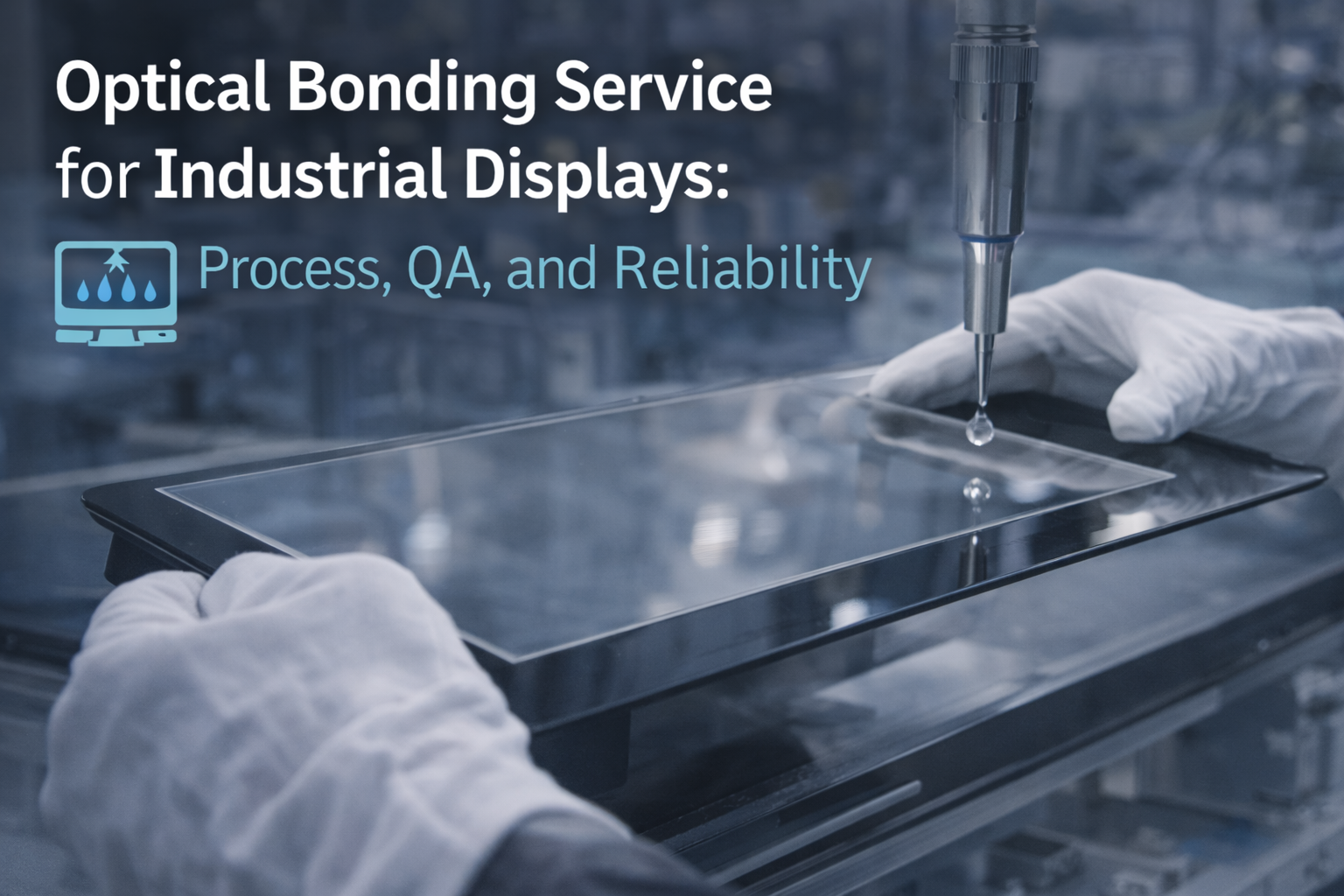
Optical Bonding Service for Industrial Displays: Process, QA, and Reliability
“Optical bonding” is not only a material choice. A real optical bonding service includes process control, inspection standards, and reliability validation.
This page explains what you should expect from a qualified supplier—so your bonded displays stay clear and stable after heat, vibration, and long-term use.
Bubble & Haze Control
Yellowing Prevention
Reliability Validation
What an optical bonding service should include
Optical bonding is often described as “removing the air gap.” In industrial reality, the value comes from consistency and stability:
controlled adhesive thickness, repeatable lamination, and proven reliability under temperature cycling.
Adhesive choice must match your glass coatings (AG/AR/AF), operating temperature range, and expected life. A good service includes compatibility checks.
Vacuum lamination, curing parameters, and cleanroom discipline determine bubble rate and yield.
Clear acceptance criteria for bubbles, haze, Newton rings, edge voids, and cosmetic defects.
Thermal cycling and long-run checks reduce field returns and “late-stage surprises.”
If your project also includes PCAP integration and touch stability, review:
High-Brightness + Optical Bonding + PCAP Integration.
OCA vs LOCA: which is used and why
Both methods can work, but each has different risk profiles and process requirements.
| Bonding method | Typical advantages | Typical risks (what to control) |
|---|---|---|
| OCA (Optically Clear Adhesive film) | Stable thickness, cleaner process, strong repeatability | Edge lamination discipline; compatibility with coatings; controlling trapped micro-bubbles |
| LOCA (Liquid Optical Clear Adhesive) | Can fill small surface irregularities; flexible for certain stack designs | Curing control, shrinkage, contamination sensitivity, higher process variability if not controlled |
Your best choice depends on cover lens structure, touch sensor type, and mechanical constraints.
For stack basics, see:
Touch Screen Structure & Bonding Methods.
Optical bonding process (step-by-step)
The exact steps vary by stack, but a high-quality optical bonding service generally follows this structure:
- Incoming inspection: check glass flatness, coatings, cleanliness, and cosmetic limits.
- Pre-clean: controlled cleaning and ionized air to remove particles.
- Alignment: precision positioning of cover lens / sensor / LCD to avoid edge offset.
- Vacuum lamination: apply adhesive under controlled pressure and vacuum environment.
- Cure / stabilization: controlled curing (as required) and time to reach stable optical properties.
- Final inspection: bubble/haze checks, edge void checks, visual clarity under defined lighting.
- Reliability sampling: thermal cycle sampling for process confidence in pilot builds.
If you need a repeatable sign-off method for touch displays, use:
Touchscreen Test Checklist.
Quality inspection: what “good” looks like
Optical bonding quality is not only “no big bubbles.” Industrial acceptance is about defect type, defect location, and long-term stability.
Define acceptance zones early (center viewing area vs bezel zone), then audit against a consistent standard.
Define maximum size and allowed count per zone. Also define whether edge bubbles are acceptable inside the black border area.
Low haze is critical for premium readability. Confirm inspection under a consistent light source and viewing angle.
Often driven by flatness mismatch and pressure distribution. Good suppliers control stack tolerance and lamination parameters.
Edge adhesion margin is a reliability issue. Define edge void limits and seal approach early.
Optical bonding frequently interacts with PCAP stability in harsh environments (moisture, EMI). For environment planning:
PCAP for Harsh Environments.
Reliability tests for industrial deployment
A key difference between “consumer bonding” and “industrial bonding” is reliability validation. If the bond yellows, bubbles grow, or edges separate after heat cycles,
field replacement costs quickly exceed any upfront savings.
Confirms bubble growth resistance and long-term adhesion stability.
Screens for outdoor enclosures must maintain clarity after heat exposure; this is where yellowing risk is revealed.
Verifies that the bond does not crack or separate under real mounting conditions.
Especially for touch displays: stability drift and cosmetic defects can appear after warm-up.
If you need a structured QA approach, see:
Touchscreen Tester (Industrial QA Guide).
DFM inputs that reduce bonding risk
Provide these inputs to your optical bonding supplier to reduce iteration cycles and avoid cosmetic disputes:
Define visible area and mask zone; agree which defects are acceptable inside the mask.
Coating compatibility matters. The bonding adhesive must match the coating chemistry for long-term stability.
Temperature range influences adhesive selection and the reliability test plan.
Mounting pressure, bezel design, and gasket placement affect stress distribution on the bonded stack.
If you also want cost transparency for bonding projects, see:
Industrial Touch Screen Price Guide.
FAQ
What should I expect from an optical bonding service?
A complete service includes material selection, controlled lamination, inspection standards, and reliability validation. It is not only “apply adhesive and press.”
Is OCA better than LOCA for industrial displays?
Not always. OCA is often more repeatable, while LOCA can be useful for certain stacks. The correct choice depends on your cover lens, coatings, and reliability targets.
How do you control bubbles and haze?
Bubble and haze control requires cleanroom discipline, correct lamination parameters, and defined inspection standards. Sampling reliability tests also helps catch process drift early.
What causes yellowing over time?
Yellowing is typically related to adhesive chemistry, heat exposure, and UV/thermal aging conditions. Industrial projects should include aging tests to confirm stability.
Can optical bonding affect PCAP touch stability?
Yes. Optical bonding changes the stack and can influence signal levels and noise behavior. Industrial projects should validate touch stability with a checklist before pilot production.
Need an optical bonding plan with clear QA acceptance criteria?
Send your cover lens drawing, coatings, temperature range, and target stack (LCD + touch sensor). We will propose an optical bonding process and a validation plan.