Technical White Paper: Engineering Standards for Medical-Grade Touch Screen Interfaces
A Comprehensive Analysis of Durability, Safety, and User Experience in Clinical Environments
In the rapidly evolving landscape of healthcare technology, the Human-Machine Interface (HMI) has transitioned from a peripheral component to a mission-critical safety feature. Whether integrated into a surgical robot, a bedside patient monitor, or a mobile diagnostic cart, the medical touch screen monitor serves as the primary gateway for data visualization and real-time clinical decision-making. Unlike consumer-grade tablets, medical displays must withstand an environment defined by aggressive sterilization, high electromagnetic noise, and the non-negotiable requirement for absolute uptime.
This technical guide explores the five foundational pillars of medical HMI engineering, providing design engineers and procurement leads with the data required to navigate complex integration challenges.
I. Chemical Resilience and Structural Hygiene
Infection control is the cornerstone of hospital administration. HMIs are high-touch surfaces that act as potential vectors for hospital-acquired infections (HAIs). Consequently, they are subjected to “washdown” protocols involving chemicals that would deteriorate standard plastics and optical coatings within weeks.
The Challenge of Accelerated Degradation
Standard displays often use anti-reflective (AR) coatings that are susceptible to hydrolysis or chemical delamination when exposed to quaternary ammonium compounds or 70% isopropyl alcohol. For a monitor like the Ever Glory YL-GZYW01Q15TC-V1, we utilize 7H Surface Hardness tempered glass. This material is inert to most hospital-grade disinfectants, ensuring that the optical clarity remains constant even after thousands of wipe-down cycles.
True-Flat Design and Sealing
Hygiene is also a matter of mechanical design. “True-flat” front panels eliminate the bezel-gap common in older monitors. By removing these crevices, engineers prevent the accumulation of bio-contaminants, allowing for a seamless “spray-and-wipe” workflow. When combined with an aluminum profile construction, the device gains the structural rigidity needed to maintain a liquid-tight seal under mechanical stress.
II. Electromagnetic Compatibility (EMC) and Patient Safety
The operating room is a “noisy” environment—not acoustically, but electromagnetically. High-frequency electrosurgical units, ventilators, and MRI machines generate significant electromagnetic interference (EMI). For a Projective Capacitive (PCAP) touch screen, this noise can be interpreted by the controller as a “touch event,” leading to catastrophic unintended consequences.
Advanced Noise Suppression
To combat this, medical HMIs require sophisticated controller tuning. Utilizing EETI or Ilitek chipsets, engineers can implement frequency hopping and high signal-to-noise ratio (SNR) thresholds. This ensures that the monitor only responds to the human finger or a stylus, ignoring the electrical spikes from nearby equipment. Our monitors are tested to Air ±8kv (Level B) and Contact ±4kv ESD, ensuring that static discharge from a mobile cart does not reboot the system or cause a freeze during a critical procedure.
III. Interface Responsiveness in Clinical Workflows
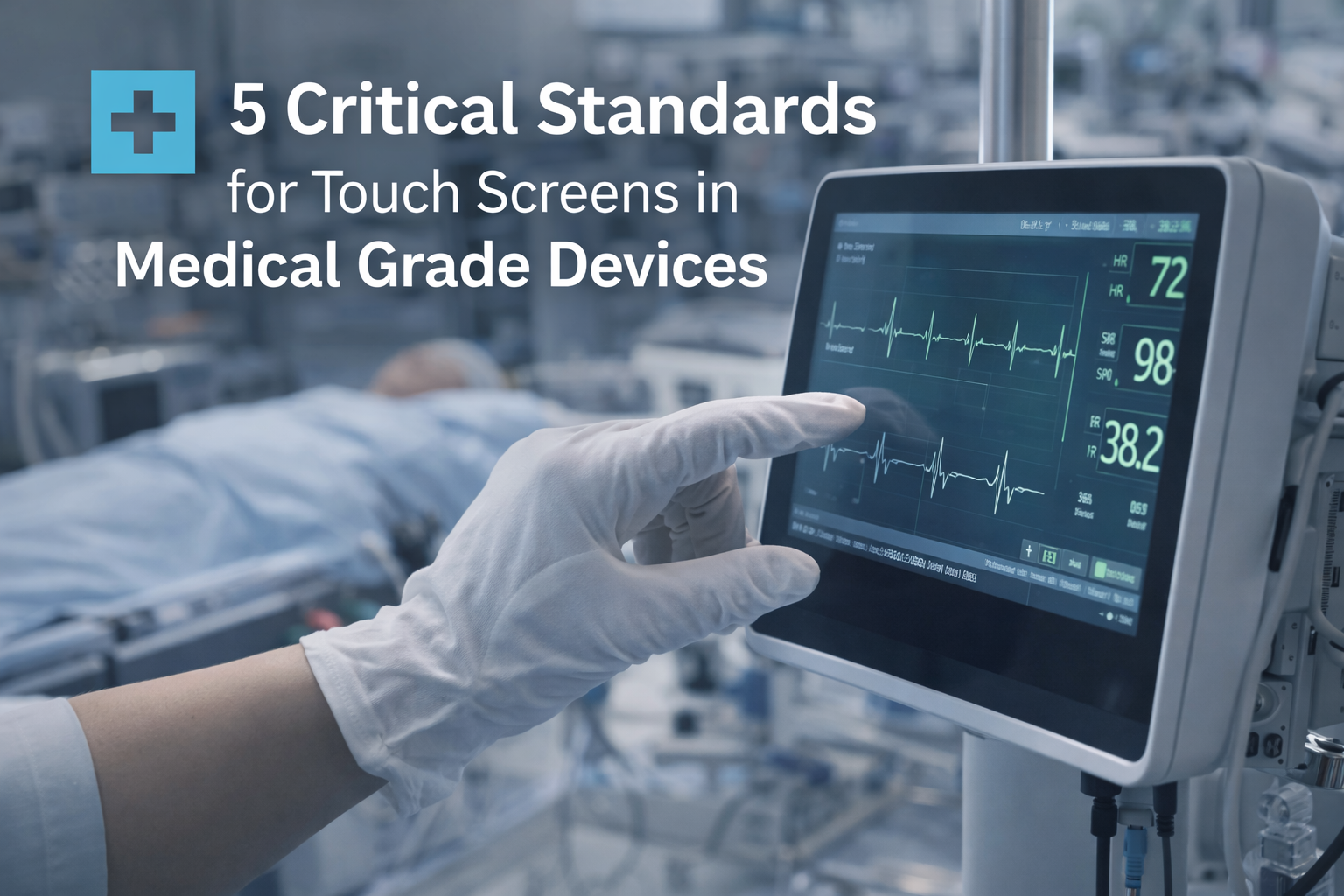
A surgeon’s focus must remain on the patient, not the screen. If a touchscreen requires multiple taps to activate a menu, it increases cognitive load and surgical time. The challenge lies in the “Glove Problem.” Capacitive touch screens work by detecting the electrical properties of the human body. Gloves act as insulators, weakening this signal.
Glove and Wet Touch Calibration
Professional medical displays must be pre-calibrated for multi-layer glove touch. This involves increasing the sensitivity of the PCAP sensor grid without making it so sensitive that it triggers from proximity. Furthermore, moisture—whether from saline or perspiration—can cause “false drags.” Professional HMI solutions incorporate algorithms that recognize the difference between a liquid drop and a purposeful finger press, providing fluid 10-point multi-touch even in high-stakes, “messy” environments.
IV. Optical Fidelity for Diagnostic Confidence
In diagnostics, every pixel counts. A Full HD 1920×1080 resolution on a 15.6-inch display offers the ideal pixel density for viewing complex waveforms and alarm metrics. However, resolution is only part of the equation.
Viewing Angles and Contrast
Medical professionals often view screens from acute angles while attending to a patient. A monitor with poor viewing angles will suffer from “color shift,” which can make a red alarm look orange, or obscure vital statistics. By utilizing 89/89/89/89 wide viewing angle panels with a 3000:1 contrast ratio, we ensure that the HMI remains readable from anywhere in the room, under any lighting condition, from harsh surgical lights to the dimmed environment of an ICU at night.
V. Lifecycle Management and Total Cost of Ownership (TCO)
The average medical device development cycle spans 2 to 5 years, followed by a decade of market life. Consumer-grade components operate on a 12-month lifecycle, which is incompatible with medical regulations. If a display component goes End-of-Life (EOL), the manufacturer must undergo a costly re-certification process with the FDA or CE.
The 10-Year Continuity Promise
Industrial HMI providers like Ever Glory offer long-term availability (5–10 years). This continuity is the “hidden” standard of medical engineering. It protects the manufacturer from unplanned engineering overhead and ensures that hospitals can maintain a consistent fleet of devices without varying hardware configurations, which simplifies staff training and maintenance.