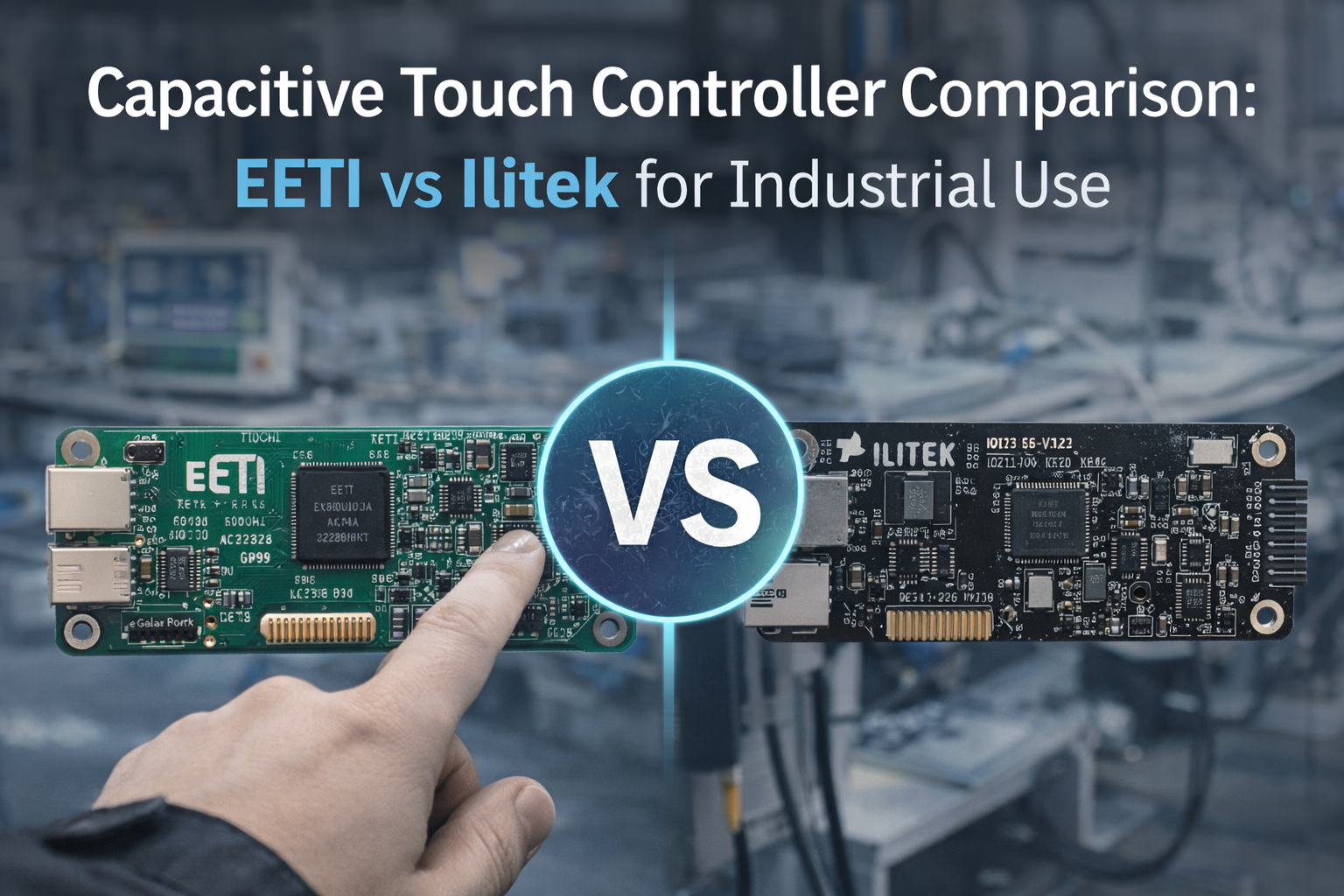
Capacitive Touch Controller Comparison: EETI vs Ilitek for Industrial Use
In industrial PCAP projects, the touch controller is not a small detail. It is the “brain” that decides whether your touch stays stable under EMI noise, gloves, water, thick cover glass, and long cables. This guide provides a detailed comparison of ETI vs Ilitek touch controllers at an engineering level, then gives a practical selection workflow.
When the controller choice really matters
If your touch screen is used in a clean office, almost any controller may feel fine. However, industrial deployments are different. The controller becomes critical when your product hits one or more of these conditions:VFD motors, inverters, switching power supplies, long I/O cables, and metal enclosures can inject noise into the touch stack.
Food lines, washdown zones, outdoor kiosks, and medical workflows need stable touch with gloves and moisture.
AG/AR/AF coatings, thicker glass, or vandal-resistant stacks change signal levels and require tuning.
HMI buttons near bezels demand stable edge tracking, not only center-area touch.
If your project is “harsh environment PCAP”, start with the controller discussion early. Also review our PCAP deployment notes: Capacitive Touch Screen (PCAP) for Harsh Environments.
EETI vs Ilitek: comparison at a glance
There is no universal “best”. The right controller depends on your touch stack, your target OS, and your EMI/water requirements. Use this table as a quick framing tool, then confirm with real tests.| Criteria | EETI (typical strengths) | Ilitek (typical strengths) |
|---|---|---|
| Industrial deployment maturity | Often used in HMI/kiosk ecosystems with common OS integration paths | Common in a wide range of embedded projects; good options for customization |
| Firmware tuning flexibility | Stable baseline; tuning packages available for gloves/wet and noise scenarios | Strong tuning potential when you have clear requirements and validation support |
| Noise immunity strategy | Good results when paired with a well-designed sensor stack and grounding | Strong results possible with correct stack + firmware + system-level EMI mitigation |
| System integration | Frequently straightforward on mainstream embedded OS paths | Works well, but integration depth depends on target OS and driver plan |
| Best fit projects | Fast-to-market industrial HMIs where stability and known integration is key | Projects needing deeper customization, special stacks, or performance tuning |
The safest way to decide is to run a short validation build. If you need a repeatable QA process, use: Touchscreen Test Checklist and Touchscreen Tester (Industrial QA Guide).
Key selection factors (what to ask your supplier)
Many controller comparisons fail because they look only at chip names. In reality, stability comes from the full touch stack: cover lens, sensor, controller, grounding, cable, and host system. Ask these questions before locking any controller.What sensor type are you using (G+G / G+F / G+FF)? What electrode pattern? What cover glass thickness? The controller must match the sensor’s electrical profile.
I²C / USB / UART is not only wiring. It decides driver availability, latency, and field maintenance complexity.
Define glove type and thickness. Define water condition (splashes, condensation, washdown). Then confirm the tuning profile and acceptance criteria.
List nearby noise sources: VFD, inverters, switching PSU, relays. Controller choice helps, but system grounding and shielding usually decide success.
If UI buttons sit near bezels, require an edge test plan. Many “works in lab” builds fail only at the edges after assembly.
Ask who maintains tuning files, how revisions are tracked, and how field updates are supported across OS versions.
If your product is outdoor and sunlight readable, controller tuning often interacts with glass and bonding choices. Related engineering notes: Sunlight Readable Displays: 1000–1500 nits Explained and High-Brightness + Optical Bonding Integration.
A fast decision workflow
Use this workflow to avoid months of “trial and error”:- Lock the touch stack first: cover glass thickness, coating, sensor type, cable length, and mounting method.
- Define the failure modes: ghost touch, missed touch with gloves, edge dead zones, drift under noise, water false touches.
- Choose 2 controller candidates: typically EETI and Ilitek profiles that match your stack and OS plan.
- Build two prototypes: keep everything else identical, only change the controller path.
- Run the same checklist: compare pass/fail and margin, not “feels OK”.
- Freeze tuning + acceptance criteria: then move into pilot production.
Validation and sign-off tests (field-friendly)
Controller decisions should be validated like an engineering component, not like a demo app. Therefore, use a repeatable test set.Test corners and bezel-adjacent buttons. Repeat after assembly torque and thermal cycles.
Use real gloves and real water patterns. Define “false touch rate” and rejection behavior.
Run touch while switching motors/loads. Log events. Also test with long cables if your design uses them.
Leave the system on for 24–72 hours and repeat tests. Many issues only appear after warm-up.
Use these two references to standardize your sign-off: Touchscreen Test Checklist and Touchscreen Tester (Industrial QA Guide).
Common mistakes that cause “ghost touch”
- Changing the cover glass thickness after tuning is frozen.
- Routing touch cables near high-current power lines without shielding strategy.
- Ignoring grounding between sensor, metal frame, and system earth.
- Testing only a demo app instead of full UI, edges, and real workflows.
- Skipping water behavior definitions (what should happen when water is present?).
For IP and sealing planning, see: IP65 Waterproof Touch Screen: Design & Test.
Engineering Update: How to Validate EETI vs ILITEK on the Same PCAP Stack
Quick answer: neither EETI nor ILITEK is automatically better for every industrial PCAP project. The safer decision is an A/B validation using the same sensor, cover glass, LCD, FPC, enclosure, OS and cable length.
| Validation item | Why it matters | Pass condition |
|---|---|---|
| Finger and multi-touch baseline | Confirms normal touch accuracy before adding difficult conditions. | No drift, no missed points and stable edge response. |
| Glove touch | Controller sensitivity and noise margin change with glass thickness and glove type. | Specified glove type works without excessive false touches. |
| Wet finger / water droplets | Water stability depends on firmware, grounding, coating and front structure. | Wet finger remains usable and standing droplets do not trigger repeated false touches. |
| EMI environment | Industrial machines may include motors, inverters, chargers or long cables. | Touch remains stable when the target equipment is operating. |
| OS and interface | USB/I2C driver behavior can affect integration and recovery after sleep or reboot. | Correct driver, wake behavior and report rate in the final system. |
For RFQ review, send the sensor stack, cover glass thickness, coating, interface, OS, cable length, required glove type, wet-touch condition and expected EMI environment. This lets EverGlory recommend a controller profile based on test margin instead of brand preference.
FAQ
Is EETI always better than Ilitek for industrial touch?
No. The “better” controller depends on your sensor stack, OS, EMI environment, and glove/wet requirements. The safest method is an A/B prototype using the same test checklist.Can firmware tuning solve water false touches by itself?
Often it helps, but water stability usually needs both firmware tuning and physical stack choices (glass coating, sealing strategy, grounding, and bezel design).Does a higher report rate automatically mean better industrial touch?
Not always. Industrial touch success is more about stability margin. A slightly lower report rate with better noise immunity can outperform a “fast” controller that drifts or false-touches.What information should I send to get a correct controller recommendation?
Send size, sensor type (G+G/G+F), cover glass thickness, coatings (AG/AR/AF), interface (I²C/USB), cable length, OS, and the exact glove/water/EMI scenario.Should I lock the controller before choosing optical bonding or glass?
Lock the stack concept first. Glass thickness and bonding choices change signal levels. Therefore, align glass/bonding and controller tuning as one design decision.Do you support both EETI and Ilitek options?
Yes. We typically select the controller profile based on your stack and environment, then validate using an agreed checklist before pilot production.Need a controller recommendation for your PCAP stack?
Share your size, cover glass thickness, interface, OS, and the real environment (water, dust, oil, EMI). We will recommend a controller path and a validation checklist.