The way a touch panel is bonded to an LCD has a direct impact on readability, reflection, moisture resistance, vibration durability, touch experience, manufacturing cost and long-term reliability. Air bonding and optical bonding are both widely used, but they are designed for different application priorities. Choosing the right bonding method depends on where the display will be used, how it will be maintained, and what performance level the final device must achieve.
What Air Bonding and Optical Bonding Mean
In a touch display module, the touch panel, cover glass and LCD can be assembled using different bonding methods. The two most common options are air bonding and optical bonding.
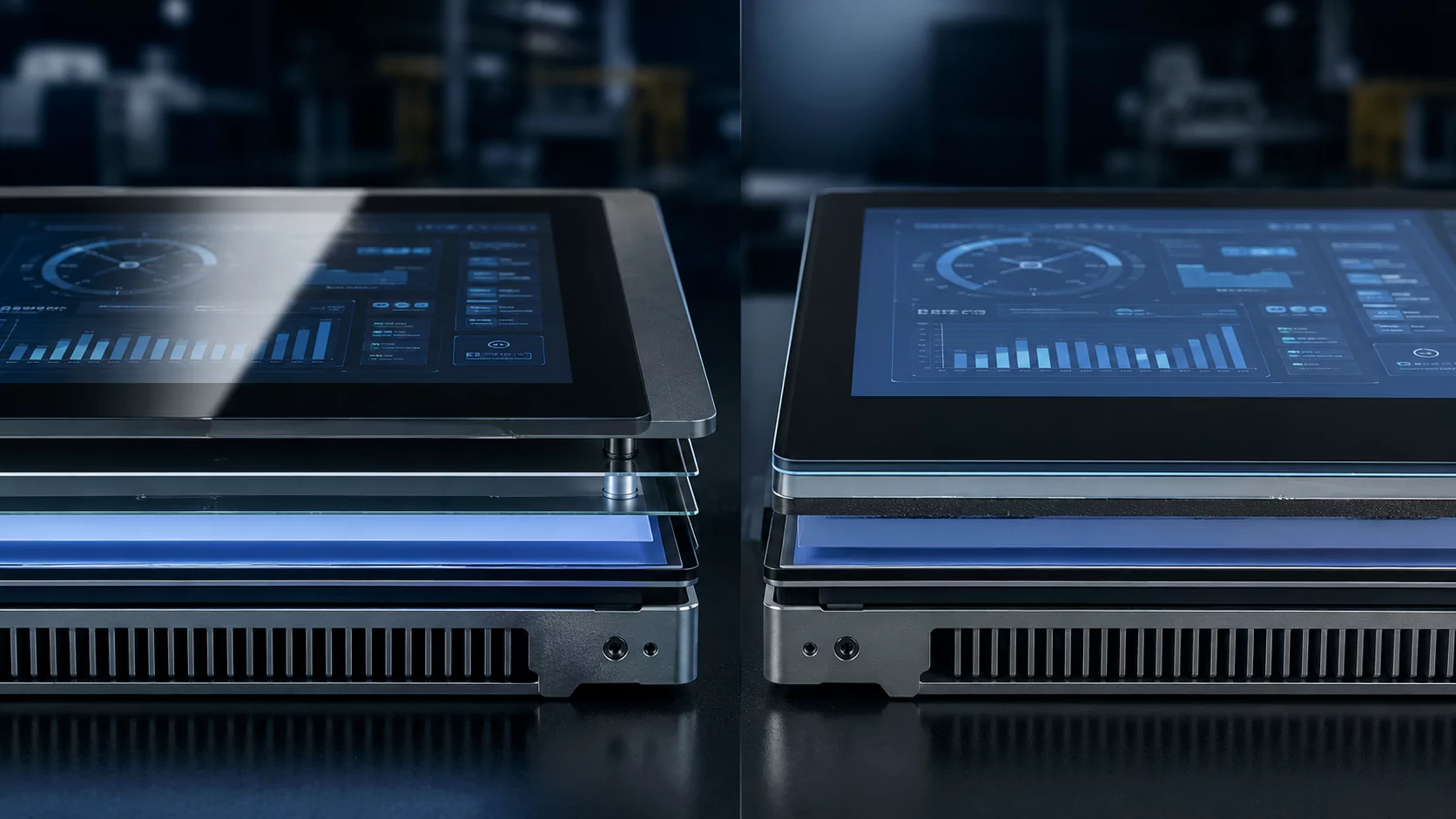
Air bonding, also called frame bonding or perimeter bonding, uses adhesive tape or frame adhesive around the edge of the display. A thin air gap remains between the touch panel and the LCD. Optical bonding, also called full lamination, fills the gap between the touch panel and the display with a transparent optical adhesive such as OCA, OCR or LOCA, creating a more integrated optical and mechanical structure.
Structural Differences Between Air Bonding and Optical Bonding
Air Bonding
Air bonding uses double-sided adhesive tape or a perimeter adhesive frame to bond the touch panel to the LCD only around the edges. Because an air gap remains between the layers, internal reflection can occur at the glass-air and air-LCD interfaces.
- Lower process complexity
- Lower manufacturing cost
- Easier rework and replacement
- Higher reflection risk due to the air gap
- More vulnerable to dust or moisture if edge sealing is insufficient
Optical Bonding
Optical bonding fills the internal gap with a transparent optical adhesive. This reduces internal reflection, improves structural rigidity and helps prevent dust or moisture from entering the display stack.
- Better optical clarity and contrast
- Improved sunlight readability
- Stronger resistance to vibration and impact
- Better sealing against dust and moisture
- Higher cost and more difficult rework
Air Bonding vs Optical Bonding: Performance Comparison
| Parameter | Air Bonding | Optical Bonding |
|---|---|---|
| Optical Structure | Touch panel and LCD are separated by an air gap. | The gap is filled with optical adhesive for a fully laminated structure. |
| Light Transmission | Typically lower due to multiple reflection interfaces. | Typically higher because internal reflection is reduced. |
| Sunlight Readability | Limited in strong ambient light unless brightness is increased significantly. | Better contrast and readability under strong light or outdoor conditions. |
| Reflection Control | More internal reflection because of the air gap. | Reduced reflection because the optical adhesive replaces the air interface. |
| Shock and Vibration Resistance | Basic resistance; internal movement may occur under vibration or impact. | Enhanced mechanical stability because the stack is bonded as one structure. |
| Moisture and Dust Protection | Depends heavily on edge sealing quality. | Better internal sealing because the air cavity is eliminated. |
| Touch Experience | Acceptable for standard indoor applications. | Often feels more stable and visually accurate due to reduced parallax and better clarity. |
| Manufacturing Cost | Lower. | Higher due to adhesive material, bonding equipment and process control. |
| Rework Capability | Easier to rework or replace. | More difficult and often requires specialized equipment and process control. |
When to Choose Air Bonding
Air bonding is a practical choice when the project is used mainly indoors, cost control is important, and easy maintenance or module replacement is required. It is widely used in standard commercial devices and many cost-sensitive industrial applications.
Best For
- Indoor applications
- Standard commercial displays
- Budget-sensitive projects
- Products requiring easier rework
- Low to medium brightness environments
Main Advantages
- Lower production cost
- Simpler manufacturing process
- Higher rework flexibility
- Easier LCD or touch panel replacement
- Suitable for many standard indoor products
Limitations
- More internal reflection
- Lower sunlight readability
- Greater risk of dust or moisture ingress
- Lower vibration resistance than full lamination
- Possible parallax in some structures
When to Choose Optical Bonding
Optical bonding is recommended when display readability, mechanical reliability and environmental resistance are more important than the lowest possible cost. It is especially valuable for outdoor terminals, industrial HMI, automotive displays, medical equipment and high-end user interfaces.
Best For
- Outdoor and semi-outdoor displays
- Sunlight readable touch screens
- Industrial and automotive applications
- Medical and high-end control interfaces
- High vibration, humidity or temperature-change environments
Main Advantages
- Reduced internal reflection
- Improved contrast and clarity
- Better sunlight readability
- Stronger structural integrity
- Better dust and moisture resistance
Trade-Offs
- Higher material and process cost
- More complex manufacturing control
- More difficult rework
- Requires stronger bubble, haze and alignment control
- Higher process validation requirement
How to Choose the Right Bonding Method
| Application Requirement | Recommended Direction | Reason |
|---|---|---|
| Indoor commercial terminal | Air bonding | Cost and easy maintenance are usually more important than maximum optical performance. |
| Outdoor kiosk or EV charging station | Optical bonding | Strong light, moisture and temperature changes require better readability and sealing. |
| Industrial HMI | Optical bonding for harsh environments; air bonding for standard indoor use | The final choice depends on vibration, humidity, dust, oil and cleaning conditions. |
| Medical device display | Often optical bonding | Better clarity, easier cleaning and more stable structure support professional use. |
| Cost-sensitive equipment | Air bonding | Lower cost and easier repair can be more suitable when the environment is controlled. |
| High-end user interface | Optical bonding | Better contrast, reduced parallax and improved perceived quality support premium product design. |
Reliability Validation Considerations
The bonding method should be validated according to the real application environment. A display used in a clean indoor device does not need the same validation plan as a display used in an outdoor industrial terminal.
Optical Test
Check transmission, reflection, contrast, haze, clarity and visible defects after bonding.
Bubble and Haze Control
Inspect bubbles, Newton rings, uneven adhesive thickness, edge defects and contamination.
Environmental Test
Review high temperature, low temperature, humidity, thermal cycling and UV exposure when required.
Touch Function Test
Confirm touch sensitivity, linearity, drift, edge accuracy, glove touch and wet touch performance after bonding.
everglory Bonding Solution Approach
everglory provides customized touch display modules for industrial, outdoor, automotive, medical and self-service terminal applications. For bonding selection, our engineering team reviews the complete display stack, including cover glass, touch sensor, LCD, adhesive, brightness, surface treatment, structure and reliability requirements.
Application Review
We review whether the display is used indoors, outdoors, in high vibration, under strong light, or in a moisture-prone environment.
Stack Design Recommendation
We help select air bonding or optical bonding based on optical target, cost, rework need, thickness, touch performance and reliability requirement.
Process and Quality Control
For optical bonding projects, we focus on adhesive selection, alignment, bubble control, haze control, edge sealing and final touch-function verification.
Air Bonding vs Optical Bonding FAQ
Is optical bonding always better than air bonding?
Why does optical bonding improve sunlight readability?
Can air-bonded displays be used outdoors?
Is optical bonding difficult to repair?
Can everglory recommend the right bonding method for my project?
Need help choosing between air bonding and optical bonding?
Share your display size, application environment, brightness requirement, touch conditions, cost target, sealing requirement and reliability expectations. everglory can help review the bonding structure and recommend the right touch display module solution.
Email Us
admin@evergloryltd.com
Email Us
admin@evergloryltd.com