.png)
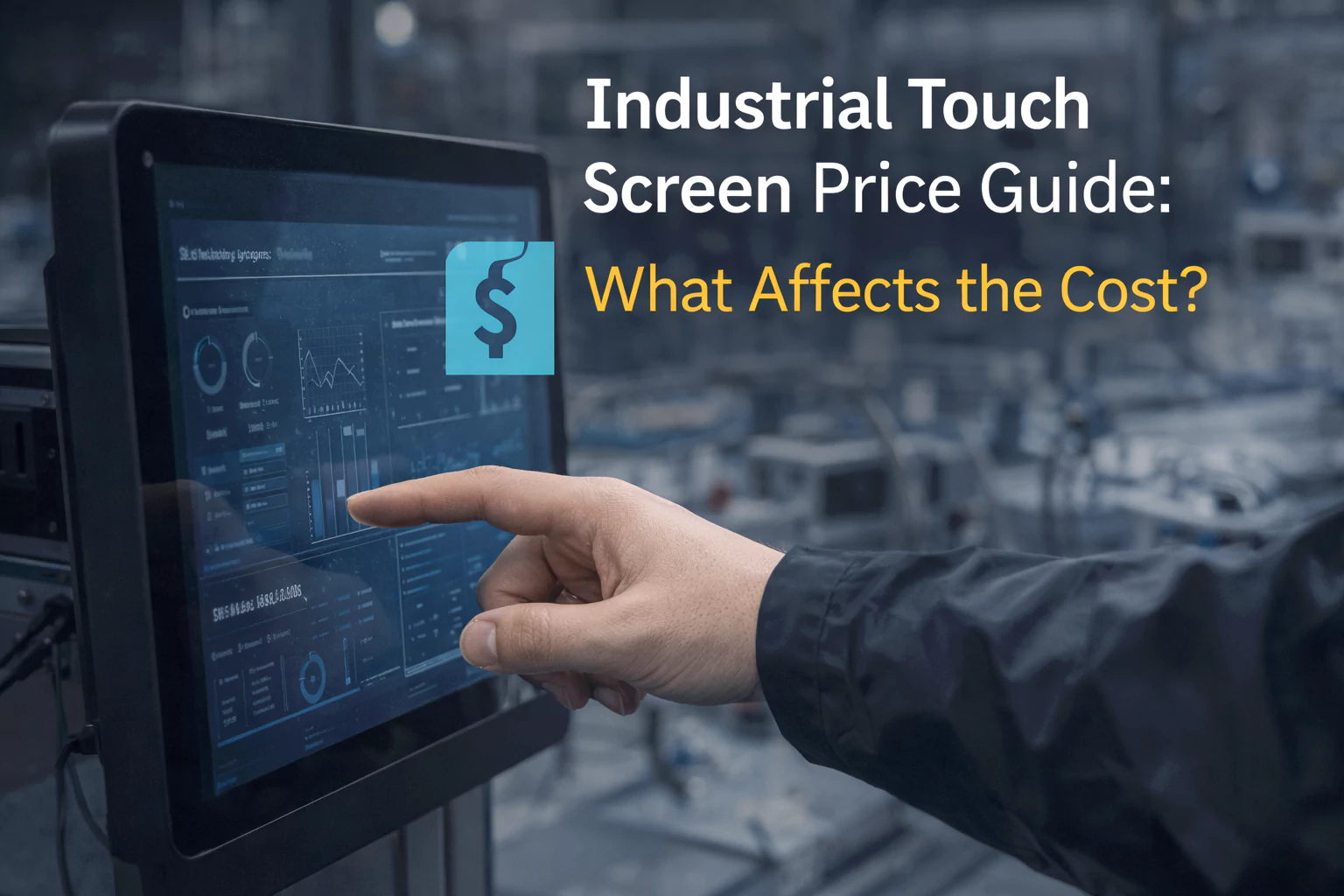
Industrial Touch Screen Price Guide: What Affects the Cost?
“Industrial touch screen price” is rarely a single number. In practice, price is the result of a specification stack:
brightness, touch structure, optical bonding, IP sealing, controller tuning, certifications, and project volume.
This guide breaks down the real cost drivers so you can budget correctly and avoid expensive redesigns.
Optical Bonding
IP65 Sealing
Customization
TCO / Reliability
Why price is a “spec stack”
Two screens can look the same on a datasheet, yet differ significantly in cost. That is because industrial performance is built from layers:
LCD + backlight, touch sensor, cover glass, controller + tuning, bonding, sealing, and validation.
Therefore, the best way to budget is to decide which layers are mandatory for your environment, then choose a configuration that meets the reliability target.
If your project is outdoor or high glare, review brightness planning first:
Sunlight Readable Displays: 1000–1500 nits Explained.
For bonding integration notes, see:
High-Brightness + Optical Bonding Integration.
Core cost drivers (most projects)
| Cost driver | What changes | Why it affects price |
|---|---|---|
| Size + resolution | Panel size, FHD/QHD, aspect ratio, viewing angle | Bigger and higher-spec LCDs increase panel cost and may require stronger backlight or housing |
| Touch structure | G+G / G+F / G+FF, sensor pattern, edge design | Different structures change yield, durability, and tuning effort |
| Cover glass thickness + treatments | Thickness, chemical strengthening, AG/AR/AF, black border | Material + coating processes add cost, but often reduce glare and field returns |
| Touch controller + firmware tuning | Controller path, interface, glove/wet/EMI profiles | Industrial stability depends on tuning. This is often the difference between “works in lab” and “works on site”. |
| Bonding method | Air gap vs optical bonding | Optical bonding improves readability and robustness, but adds process and validation cost |
| Mechanical design | Open frame vs housing, VESA/panel mount, connector panel | Metal parts, sealing features, and assembly steps increase cost but simplify deployment |
If you are buying a finished monitor series, start here:
Industrial Touchscreen Monitors (PCAP Series).
If you need a custom touch panel for OEM integration, start here:
High-Stability PCAP Touch Panel.
Environment-driven costs (outdoor, washdown, oil)
Environment requirements often drive cost more than screen size. That is because they introduce additional layers: sealing, coatings, brightness,
and reliability validation.
Sealing needs gaskets, mechanical tolerance control, and verification. It is not “just a rubber ring”.
Higher brightness plus thermal design is needed. Optical bonding and AR/AG choices also affect perceived contrast.
Related: 1000–1500 nits planning
Requires the correct controller profile plus a compatible touch stack. This can affect both BOM and engineering time.
Related: PCAP for Harsh Environments
Contamination can change touch signals. Often you need AF coating, tuning, and a cleaning plan to keep touch stable.
Engineering/NRE costs you should plan for
Many buyers focus only on unit price. However, industrial projects also have engineering costs. If you plan for them early, your total project cost becomes more predictable.
- Sample builds and iterations: different glass/coating, different controller profiles, different sealing designs.
- Touch tuning and acceptance criteria: glove type, wet behavior, edge performance, EMI noise tests.
- Mechanical integration: mounting, cutout drawing, connector position, cable strain relief.
- Reliability validation: thermal cycling, vibration, long-run drift checks.
- Documentation package: spec sheet, test records, and change control.
If you want a repeatable validation workflow, use:
Touchscreen Test Checklist
and
Touchscreen Tester (Industrial QA Guide).
How to get an accurate quote fast
If you send only “15 inch touch screen price?”, the quote will be slow and inaccurate. Instead, send a short requirement set.
Then you will get a stable price range quickly.
- Define the product type: touch panel only, touch display module, touch monitor, or panel PC.
- Send size + resolution + orientation: and whether wide temperature is needed.
- Define brightness target: indoor vs outdoor (sunlight readable).
- Define touch requirements: glove, wet, stylus, edge buttons, and cable length.
- Define protection: IP rating target and whether front-only sealing is acceptable.
- Share your annual volume: and your pilot quantity. Volume changes BOM sourcing and tooling allocation.
Price vs TCO: what buyers often miss
A lower unit price can become expensive if you face field failures, high return rates, or frequent replacements.
Therefore, buyers should evaluate TCO (total cost of ownership) with three practical questions:
If touch drifts or false-touches, your service cost grows quickly.
Industrial projects need stable BOM and documented tuning, not frequent “silent changes”.
A robust mounting + connector plan reduces install time and future maintenance risk.
A repeatable checklist reduces disputes and surprises at deployment.
FAQ
What is the biggest factor in industrial touch screen price?
For many projects, environment requirements drive the biggest price change: brightness, optical bonding, IP sealing, and controller tuning for glove/wet/EMI stability.
Does optical bonding always increase cost?
Yes, it adds process and validation cost. However, it can reduce glare, improve readability, and lower field failures. In outdoor projects, it often improves TCO even if the unit price is higher.
Why do two “same size” PCAP screens have different pricing?
Because “same size” does not mean same stack. Cover glass thickness, coatings, sensor type, controller tuning, sealing design, and brightness targets can be very different.
Is it cheaper to buy a touch panel and assemble it myself?
Sometimes. However, if you need optical bonding, sealing, and stable tuning, supplier integration often reduces risk and total engineering time.
How can I reduce cost without sacrificing stability?
Start with the real environment and remove unnecessary specs. For example, keep brightness aligned to actual lighting, choose a practical IP target, and freeze a stable stack early to avoid rework.
What should I prepare before requesting a quote?
Send size, resolution, brightness target, touch requirements (glove/wet/EMI), interface, IP target, operating temperature range, and expected volume. Then the quote can be accurate and fast.
Want a transparent quote with a stable spec baseline?
Tell us your application and environment. We will propose a stack (glass + touch + bonding + sealing) and provide a clear cost breakdown.