55 Inch Touch Screen Monitor for Interactive Kiosks, Signage, and Control Terminals
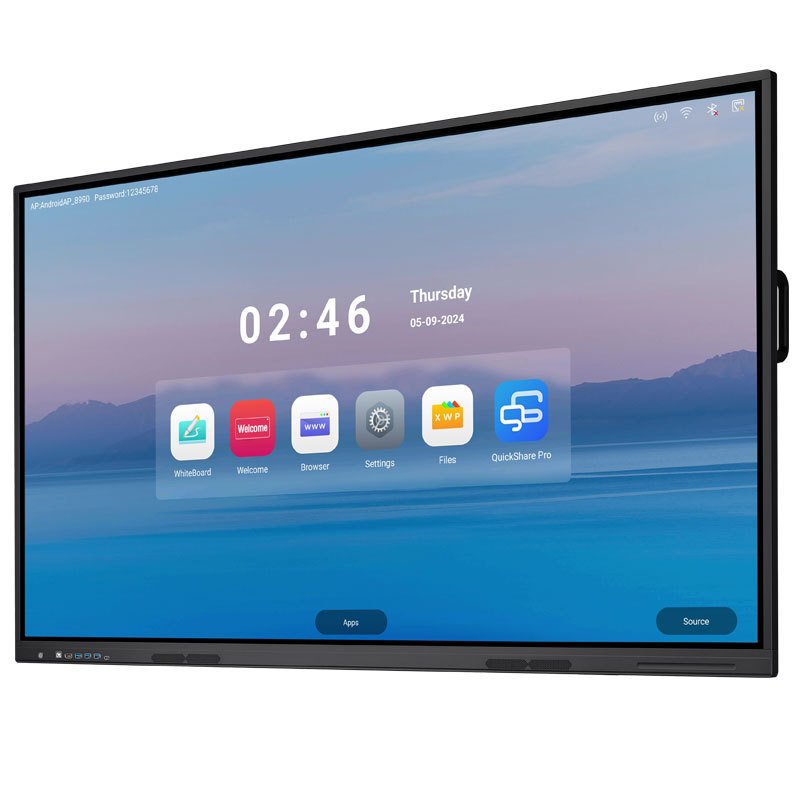
A 55 inch touch screen monitor is ideal when your project needs a large, clear interface for public interaction.
For example, it is widely used for interactive digital signage, wayfinding kiosks, exhibition displays, and control terminals.
Therefore, the design must balance readability, durability, and long-term stability.
If your deployment is outdoors or in semi-outdoor areas, start with our
Outdoor Touch Screen Solutions for Kiosks, EV Chargers, and Signage
.
It summarizes brightness, sealing, and bonding decisions for outdoor use.
Why Choose a 55″ Touch Monitor?
- Large-format UI: more space for maps, instructions, advertising, and multi-step workflows.
- Better visibility: clear content at longer viewing distances in public spaces.
- Higher engagement: supports interactive experiences for retail, exhibitions, and self-service terminals.
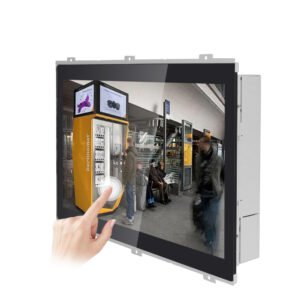
- Flexible integration: open frame / kiosk integration options can be evaluated for OEM projects.
Key Engineering Options for 24/7 and Public Use
Touch Technology: PCAP Multi-Touch
Projected capacitive (PCAP) touch provides smooth, tablet-like interaction.
In addition, it supports multi-touch gestures and fast response for modern UI designs.
If glove operation or wet touch is required, firmware tuning can be evaluated based on cover glass thickness and the real use scenario.
For PCAP fundamentals, see our
PCAP technology guide
.
Cover Glass and Surface Treatments (AG / AR / AF)
A 55-inch screen is more sensitive to reflections because of its large surface area.
Therefore, the right cover glass and surface treatment is important.
AG (anti-glare) reduces specular reflections.
AR (anti-reflective) improves contrast.
AF (anti-fingerprint) makes cleaning easier for public environments.
Sunlight Readable Brightness (When Needed)
For indoor installations, standard brightness may be sufficient.
However, semi-outdoor areas or bright indoor atriums often require higher brightness and reflection control.
In many outdoor projects, 1000 nits is a practical baseline.
For full outdoor exposure, 1500 nits can deliver better readability.
As a result, the screen remains usable under daytime conditions.
Optical Bonding for Readability and Strength
Optical bonding reduces internal reflections and improves contrast.
Therefore, the image looks clearer under strong light.
In addition, bonding increases shock resistance because there is no air gap.
This is useful for public kiosks and interactive signage that run 24/7.
Front Sealing and Easy Maintenance
Public terminals often face dust, fingerprints, and frequent cleaning.
Therefore, a flat front surface is recommended.
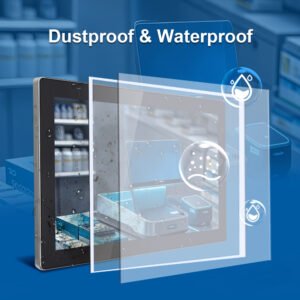
For semi-outdoor or outdoor kiosks, IP65 front sealing can be evaluated based on enclosure design and installation method.
For more detail, you can reference our engineering article:
Waterproof, Dustproof and Impact Resistance Guide
.
Integration and Customization (OEM/ODM)
Every large-format kiosk has unique requirements.
Therefore, we support engineering options based on your project needs:
- Display performance: brightness selection, wide-temperature options, and 24/7 operation review
- Touch stack-up: cover lens thickness, printing, and PCAP tuning
- Bonding: air bonding or optical bonding, depending on environment and budget
- Mechanical design: open frame / panel integration options for kiosk structures
- Interfaces: display interface options (HDMI/DP/VGA) and touch interface (USB/I2C), based on your platform
Typical Applications
- Interactive digital signage and advertising displays
- Wayfinding kiosks in malls, airports, and transport hubs
- Exhibition and showroom interactive screens
- Self-service terminals and check-in kiosks
- Control terminals for industrial and commercial systems
Recommended Next Steps
- Read:
Industrial Touch Screen Buyer’s Guide
- Explore:
Industrial Touch Products (Monitors & Modules)
- Review applications:
Solutions by Application
FAQ
Is a 55 inch touch screen monitor suitable for public kiosks?
Yes. Large-format screens improve visibility and user engagement.
However, public use should define cover glass durability, cleaning needs, and enclosure integration early.
Can you support sunlight readable configurations for outdoor kiosks?
Yes. High brightness and reflection control options can be evaluated based on the installation environment.
In addition, optical bonding can further improve contrast for outdoor readability.
Do you offer optical bonding for large touchscreens?
Yes. Optical bonding reduces reflections and increases strength.
Therefore, it is a common choice for 24/7 public terminals and semi-outdoor installations.
Can the front be waterproof?
Many kiosk designs use a sealed front structure, and IP65 front protection is common.
Final performance depends on the enclosure design, gaskets, and installation method.
Request a Quote
Send your screen size, installation type, brightness target, cover glass preference, and interface requirements.
Then we will recommend a suitable 55-inch touch monitor configuration and share a spec sheet.
Contact us here.
55 Inch Touch Screen Monitor | big Format PCAP Display for Kiosks Engineering Information
55 Inch Touch Screen Monitor | big Format PCAP Display for Kiosks is a 55 inch industrial touch screen monitor for embedded display, OEM equipment, kiosk and HMI integration. It should be reviewed with LCD model, touch interface, video input, backlight, bonding and mechanical mounting so Ever Glory can confirm integration risk before sampling or quotation.
- Product Category
- Touch Screen Monitor
- Product Role
- industrial touch screen monitor
- Size / Format
- 55 inch
- Best Fit
- embedded display, OEM equipment, kiosk and HMI integration
- Review Focus
- LCD model, touch interface, video input, backlight, bonding and mechanical mounting
- Customization
- Cover glass, touch tuning, mounting structure, interface configuration, branding, bonding and enclosure fit
Information Needed for Review
- Mechanical drawing, target installation space and 55 inch display or housing requirement.
- LCD model, touch interface, video input, backlight, bonding and mechanical mounting.
- Operating environment, brightness, temperature, IP rating, vibration, cleaning or glove-touch expectations.
- Target quantity, certification needs, cable direction, connector position and production schedule.
Typical Applications
OEM equipment, kiosks, self-service terminals, medical devices, POS systems and industrial control interfaces.
Suitable for projects where display integration, touch stability and mechanical fit require confirmation before production.
Compare related Ever Glory products in the Touch Screen Monitor category for similar integration requirements.
Common Engineering Questions
Is this industrial touch screen monitor ready for direct installation?
It depends on the final enclosure, interface, power, mounting and software environment. Ever Glory reviews the drawings and application before confirming a production-ready solution.
What information helps confirm feasibility faster?
Send LCD model, touch interface, video input, backlight, bonding and mechanical mounting, mechanical drawings, operating environment, target quantity and any branding or certification requirements.
Can Ever Glory customize this product?
Yes. Common customization includes cover glass, touch controller tuning, bonding, brightness, interface, housing, cable direction, logo printing and mounting structure.
Related Ever Glory Products
For an accurate quotation, send drawings and application details instead of only screen size.