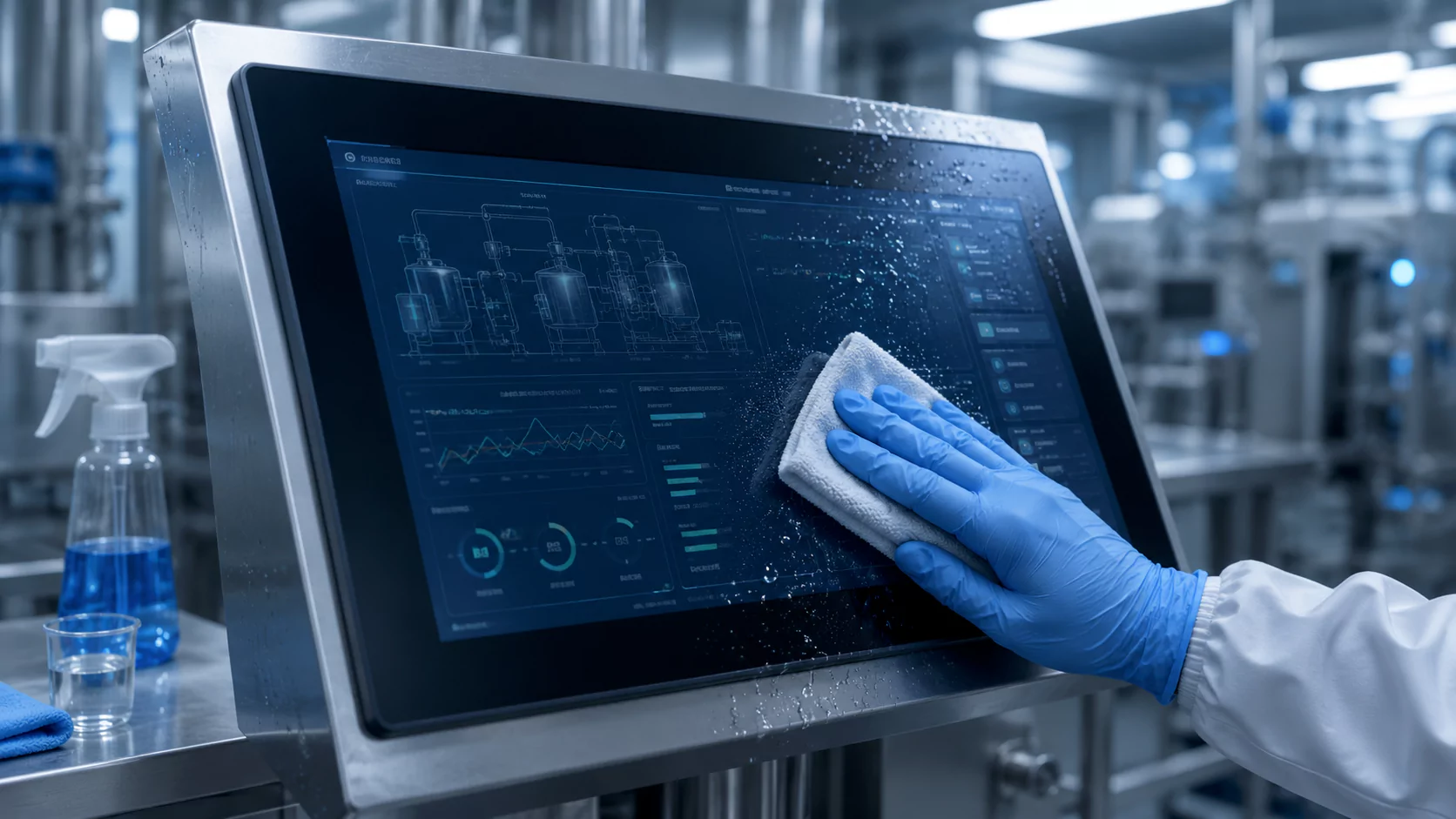
In industrial HMI, medical devices, automotive displays, outdoor kiosks, and food-service terminals, a touch screen may be cleaned many times every day. Alcohol, disinfectants, detergents, hand sanitizer, oils, and industrial cleaning agents can damage ordinary surface coatings if the touch panel is not designed and validated for chemical resistance.
Project note: Need a chemically resilient touch interface? Compare Ever Glory’s custom capacitive touch panel solutions and touch display module options, or share your cleaning and chemical exposure requirements.
What Is Chemical Resistance in a Touch Screen?
Chemical resistance refers to the ability of a touch screen cover glass, coating, sensor stack, and bonding structure to resist damage after contact with cleaning agents, disinfectants, oils, solvents, or other chemicals used in the target environment.
For industrial and medical-grade touch displays, chemical resistance is not only a cosmetic requirement. A damaged surface coating can lead to visible whitening, haze, cracks, delamination, reduced anti-fingerprint performance, unstable touch response, or long-term reliability risks.
Where Chemical-Resistant Touch Displays Are Needed
Medical Devices
Bedside terminals, diagnostic equipment, operating-room interfaces, and nurse-station displays exposed to frequent alcohol or disinfectant wiping.
Industrial HMI
Machine control panels used in oily, dusty, humid, or cleaning-intensive production environments.
Automotive Displays
Vehicle control panels exposed to hand sanitizer, sunscreen, oils, cleaning agents, and long-term temperature cycling.
Outdoor Self-Service Terminals
Kiosks, EV charging interfaces, vending machines, and ticketing terminals that require regular cleaning and weather-oriented durability.
Food and Catering Equipment
Ordering terminals, kitchen equipment, beverage machines, and food-processing HMIs exposed to detergents, grease, and repeated wiping.
Chemical or Laboratory Sites
Operator screens used near solvents, reagents, cleaning agents, or controlled laboratory cleaning processes.
Why Industrial Touch Screens Need Chemical Resistance
1. Prevent Coating Corrosion
Alcohol, IPA, chlorine-based disinfectants, detergents, hand sanitizer, oils, and solvents may attack weak surface coatings and create whitening, stains, or haze.
2. Keep Touch Performance Stable
If the coating is damaged or contaminated, the touch system may show reduced sensitivity, drifting, false touches, or inconsistent response.
3. Extend Product Service Life
A chemically resistant front surface reduces maintenance issues and helps the display remain usable in daily cleaning environments.
4. Support Industry Validation
Medical, automotive, industrial, and food-equipment projects often require defined cleaning-agent resistance as part of the product validation plan.
Key Parameters When Selecting a Chemical-Resistant Touch Display
| Parameter | What to Confirm | Why It Matters |
|---|---|---|
| Chemical List | 75% ethanol, 95% ethanol, IPA, diluted sodium hypochlorite, detergent, hand sanitizer, oil, sunscreen, or project-specific chemicals. | Different chemicals attack coatings in different ways. A claim must match the actual cleaning process. |
| Wiping Cycles | Define 500, 1,000, 5,000, 10,000, or higher wiping cycles based on the application. | High-frequency cleaning environments require more than a short visual check. |
| Contact Time | Define whether the chemical is wiped immediately, left for several minutes, or tested by immersion/contact exposure. | Longer exposure can reveal coating weakness that quick wiping may not show. |
| Surface Hardness | Review required pencil hardness such as 6H, 7H, 8H, or 9H depending on cover glass and coating design. | Hardness helps reduce visible scratching but does not replace chemical-resistance testing. |
| Coating Adhesion | Check adhesion before and after chemical exposure using a defined cross-hatch or tape test method. | Poor adhesion can lead to coating peeling, delamination, or local optical defects. |
| Optical Change | Check haze, whitening, gloss change, stains, rainbow patterns, and visible coating damage. | Even if touch still works, poor appearance can fail customer acceptance. |
| Touch Performance | Verify sensitivity, linearity, false touch, drift, and multi-touch response after chemical exposure. | The final goal is stable touch operation, not only a clean-looking surface. |
Recommended Validation Method
A reliable chemical-resistance validation plan should be built around the real use case. For example, a medical touch screen that is cleaned with 75% alcohol several times per day should not use the same test plan as an industrial HMI exposed to oil and detergent.
Step 1: Define Chemicals
List all cleaning agents, disinfectants, oils, solvents, and concentrations expected in the field.
Step 2: Define Exposure
Set wiping cycles, wiping pressure, cloth type, contact time, temperature, and humidity condition.
Step 3: Inspect Surface
Check whitening, haze, stains, cracks, peeling, scratches, gloss change, and coating loss.
Step 4: Verify Function
Confirm touch sensitivity, linearity, false touch, drift, and display readability after testing.
High Chemical-Resistance Coating vs Standard AF Coating
| Item | High Chemical-Resistance Coating | Standard AF Coating |
|---|---|---|
| Main Purpose | Resist alcohol, disinfectants, detergents, oils, and repeated cleaning. | Reduce fingerprints and improve surface smoothness. |
| Suitable Applications | Medical, industrial HMI, automotive, food equipment, outdoor kiosk, chemical-use environments. | Consumer electronics or low-cleaning-frequency environments. |
| Cleaning Durability | Can be validated for high-cycle wiping based on project requirements. | May lose performance quickly under strong disinfectants or repeated wiping. |
| Cost | Usually higher because coating material, process control, and validation requirements are stricter. | Usually lower and easier to apply for standard applications. |
| Risk if Misused | Lower risk when correctly specified and validated. | Higher risk of haze, whitening, coating loss, and customer complaints in harsh cleaning environments. |
Common Problems Caused by Poor Chemical Resistance
Whitening or Haze After Alcohol Wiping
The surface coating may be chemically attacked, creating optical haze, cloudy marks, or permanent white areas.
Coating Peeling or Delamination
Weak adhesion or poor process control can cause coating separation after repeated chemical exposure.
Touch Sensitivity Reduction
Damaged coating, residue buildup, or unstable surface properties may affect capacitive touch sensing.
Rapid Loss of Anti-Fingerprint Function
A standard AF coating may lose hydrophobic or oleophobic performance quickly under aggressive cleaning cycles.
everglory Chemical-Resistance Solution for Touch Displays
everglory develops industrial projected capacitive touch screens and bonded touch display modules for demanding applications. For projects involving alcohol wiping, disinfectants, oils, cleaning agents, or high-frequency maintenance, our engineering team can review the cover glass, surface coating, touch sensor, optical bonding structure, and validation plan as one complete system.
Material Selection
Select suitable cover glass, AF/AG/AR coating direction, hardness level, and surface treatment according to the cleaning environment.
Process Control
Control coating uniformity, curing, adhesion, optical appearance, and bonding compatibility during production.
Project Validation
Define chemical exposure, wiping cycles, acceptance criteria, and touch-function verification before mass production.
Chemical Resistance FAQ
Can a consumer touch screen be used directly in industrial equipment?
Does a chemical-resistant coating affect touch sensitivity?
Is 75% alcohol wiping enough for chemical-resistance testing?
What should be checked after chemical exposure?
Can everglory customize a chemical-resistant touch display?
Need a chemical-resistant touch display for your project?
Share your application, cleaning agents, wiping frequency, required touch behavior, cover glass requirement, and operating environment. Our team can help review the chemical-resistance requirements and recommend a suitable touch display solution.