Why Etching Paste Patterning Matters in Touch Sensor Manufacturing
In many industrial, automotive, and higher-reliability consumer touch projects, the sensor layout may use a diamond ITO pattern together with dummy structures to improve electrical balance and visual uniformity. In these designs, the patterning method is not just a manufacturing detail—it directly affects cost, dimensional control, environmental burden, and production practicality. This article explains how etching-paste patterning works, where it fits best, how it compares with conventional wet etching, and what design limits should be reviewed before process selection.
What Etching-Paste Patterning Means
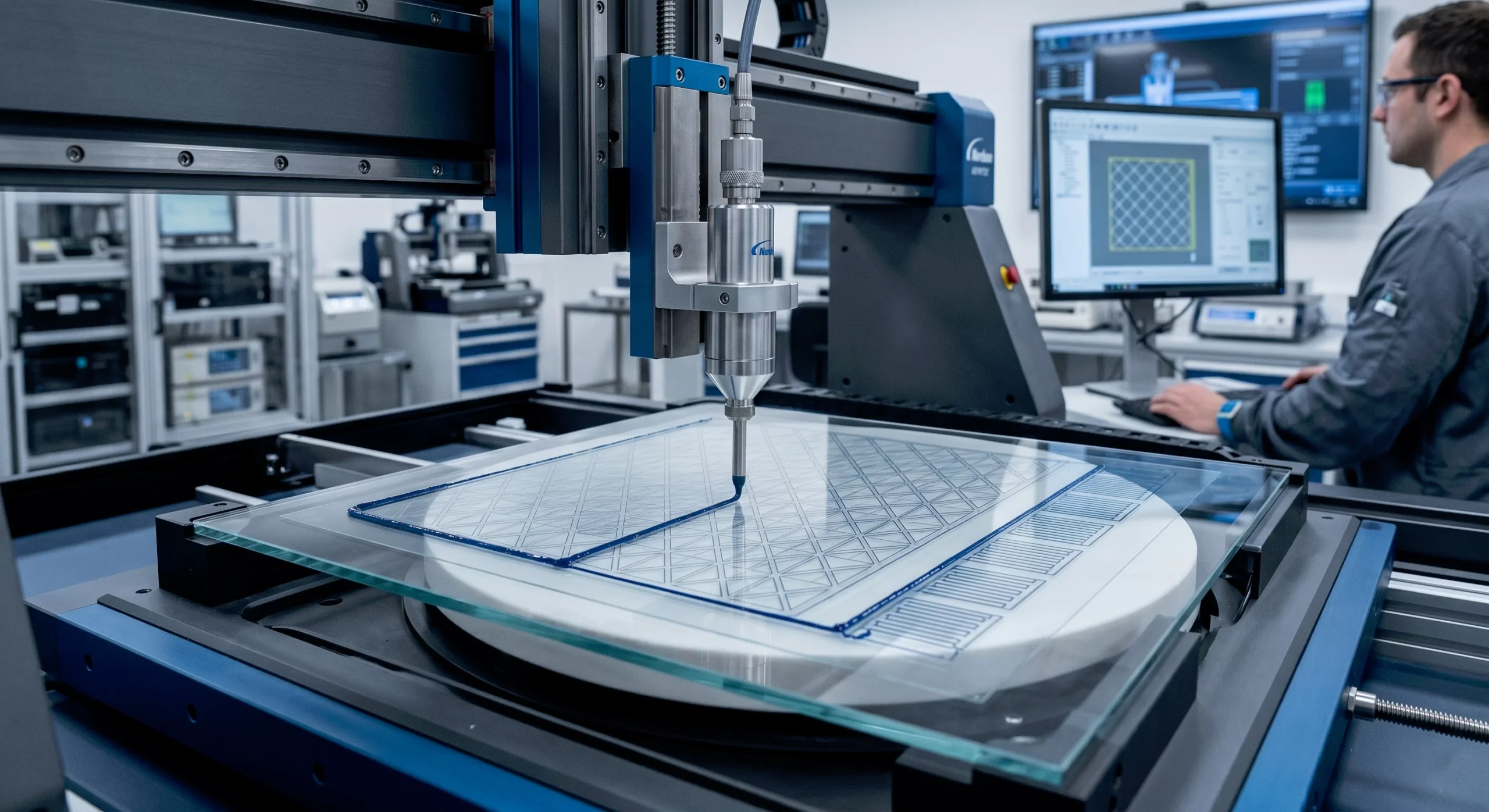
Etching-paste patterning is a direct patterning approach in which a specialized etching paste is printed only onto the ITO regions that need to be removed. Instead of immersing the entire coated substrate into a bulk wet-etch chemistry after photoresist imaging, the process uses localized printed chemistry to define the unwanted conductive area.
In touch sensor manufacturing, this approach can be especially attractive when the design uses dummy structures and the goal is to balance cost, process simplicity, and sufficient dimensional control for industrial or automotive-grade products.
Basic Process Flow
The process typically starts with an ITO-coated substrate such as glass or PET. A specially formulated etching paste is then printed in the negative pattern of the regions to be removed, including the line gaps and any dummy-related areas. After controlled reaction and curing conditions, the reacted paste and removal products are cleaned away, leaving the final conductive pattern behind.
Selective Printing
Etching chemistry is applied only where ITO removal is intended, instead of exposing the whole panel to one immersion step.
Localized Reaction
The chemical reaction takes place mainly in the printed region, which helps simplify material usage and waste handling.
Final Clean-Up
The remaining paste and reaction byproducts are removed to reveal the final ITO routing pattern.
Why It Can Be Attractive vs Wet Etching
Compared with conventional wet etching workflows, etching-paste patterning can offer several practical advantages in suitable touch sensor designs.
1. Better Material-Use Efficiency
Because the chemistry is applied only where ITO must be removed, the process can reduce unnecessary material removal compared with full-panel wet processing workflows.
2. Lower Waste-Liquid Burden
Bulk wet etching typically generates more chemical waste liquid and more demanding waste-treatment load. A selective paste-based route can reduce this burden when managed correctly.
3. Practical Fit for Dummy-Pattern Designs
In many medium-precision industrial or automotive sensor layouts, etching-paste patterning can offer a practical way to implement line gaps and dummy-related structures without the full complexity of photolithography-based workflows.
4. Good Cost-to-Process Balance
For many non-extreme patterning requirements, the process can provide a useful balance between manufacturing cost, throughput simplicity, and acceptable dimensional control.
| Comparison Area | Etching-Paste Patterning | Conventional Wet Etching |
|---|---|---|
| Chemistry Use | Localized to intended removal areas | Large-area immersion workflow |
| Waste Handling | Potentially lower liquid waste burden | Typically higher acid and metal-ion waste load |
| Process Complexity | Can be simpler in suitable medium-precision layouts | Often more established for finer photo-defined patterning |
| Best Fit | Industrial, automotive, and cost-sensitive sensor designs needing balanced performance | Higher-precision or tighter-line pattern requirements depending on design target |
Where It Fits Best
Etching-paste patterning is usually most attractive in touch sensor projects that need a practical balance between cost, environmental burden, and medium-to-high dimensional control, rather than the most extreme fine-line capability available in the market.
Industrial Touch Systems
Good fit for designs that prioritize reliability, repeatable manufacturing, and controlled cost more than ultra-fine photolithographic resolution.
Automotive Touch Interfaces
Useful for projects that need good visual consistency and practical dummy implementation without forcing the highest-cost patterning route.
Medium-Precision Sensor Designs
A practical option when the line-width and spacing targets stay within the controllable capability window of the printing process.
What Should Be Validated
Choosing the process route should be based on measurable production behavior, not only on theoretical advantage. Before locking the design, the following checks are recommended:
Pattern Dimension Control
Confirm whether the printed reaction boundary can consistently hold the target line-width, spacing, and dummy dimensions across production lots.
Capacitance Uniformity
Validate whether the final pattern supports the required electrical consistency across the active sensor area.
Visual Pattern Quality
Check whether the final ITO visibility, line-edge appearance, and dummy transition behavior remain acceptable under realistic viewing conditions.
Residue and Cleaning Quality
Ensure the paste and reaction byproducts are removed cleanly, without leaving residue that could affect reliability or optical behavior.
Yield and Throughput Stability
The real value of the process must be confirmed through yield tracking and consistency across repeat production, not only by one successful pilot.
Environmental and Cost Validation
Waste-handling, chemical consumption, and process cost should be reviewed using real production data rather than assumptions.
Engineering Takeaways
In touch sensors that use diamond ITO layouts and dummy structures, etching-paste patterning can be a strong manufacturing option when the design goal is to balance cost, process simplicity, environmental load, and practical performance.
Compared with conventional wet etching, its strongest value often lies in selective chemistry use, lower waste-liquid burden, and good suitability for many medium-precision industrial and automotive sensor designs.
FAQ
What is the main advantage of etching-paste patterning in touch sensor manufacturing?
Is etching-paste patterning always better than wet etching?
Does it work well with dummy-pattern designs?
Why is it considered more environmentally friendly in some cases?
What should be tested before using this process in production?
Need help choosing the right patterning route for a touch sensor?
If your project involves diamond ITO, dummy structures, automotive touch interfaces, or industrial-grade sensor production, our engineering team can help review the design tolerance and recommend a suitable manufacturing path.