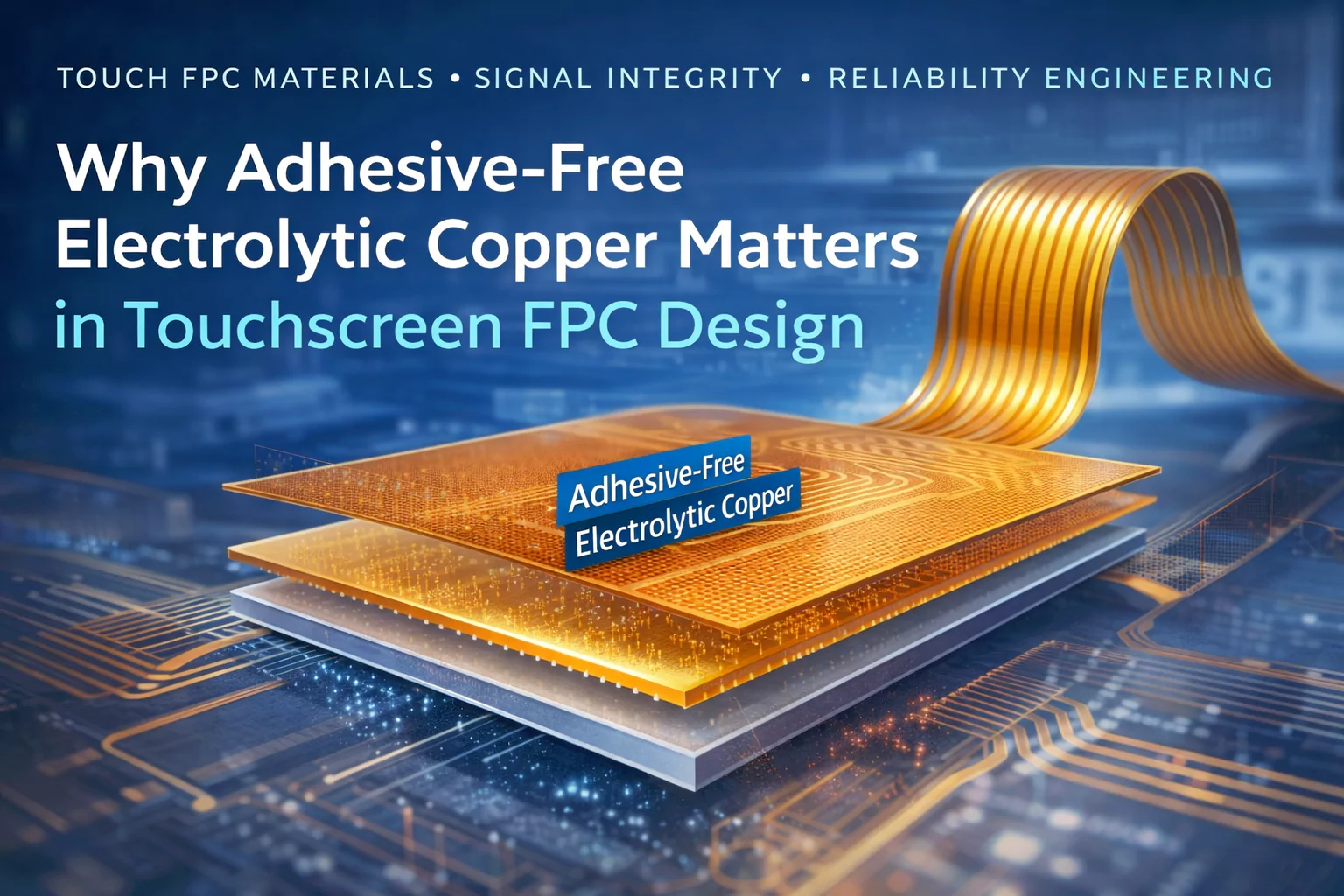
Why Adhesive-Free Electrolytic Copper Matters in Touchscreen FPC Design
In high-performance industrial and consumer touch products, FPC material selection has a direct impact on signal quality, thickness control, bend reliability, and manufacturing cost. Adhesive-free electrolytic copper can be an attractive option when the design goal is to reduce dielectric-related loss, support thinner stack-ups, and keep material cost under control. This article explains where adhesive-free ED copper fits best, why engineers choose it, and what design limits must be reviewed before final material selection.
Design Goals
The purpose of using adhesive-free electrolytic copper in a touchscreen FPC is not simply to change the copper type. It is usually part of a broader design strategy aimed at optimizing three engineering targets at the same time.
Better High-Frequency Signal Behavior
Reduce unnecessary dielectric-related loss and support cleaner signal transmission between controller and sensor routing.
Thinner and More Compact Construction
Support thinner FPC stack-ups for compact device architecture and slimmer touch module integration.
Balanced Cost and Reliability
Improve material efficiency without shifting the design into an unnecessarily expensive copper solution for every project.
Why Choose Adhesive-Free ED Copper
Compared with adhesive-based copper structures, adhesive-free constructions remove the additional adhesive layer between copper and base material. This can be useful in touch FPC designs where thickness, dielectric behavior, and process stability all matter.
1. Lower Dielectric Burden in the Stack-Up
Removing the adhesive layer can help reduce extra dielectric contribution in the transmission path. In higher-speed or more signal-sensitive touch interface layouts, this may help reduce transmission loss and support cleaner electrical behavior.
2. Better Thermal Process Margin
Adhesive-free constructions can provide better stability in some lamination, soldering, or thermal process conditions by reducing one possible interface weakness in the material stack.
3. Thinner Material Structure
Without the adhesive layer, the overall copper-clad stack can be thinner, which is helpful in products that need aggressive thickness control.
4. Practical Cost Advantage in the Right Use Case
Electrolytic copper is usually more cost-effective than rolled annealed copper. In projects where extremely high dynamic flex life is not the primary constraint, adhesive-free ED copper may offer a better cost-performance balance.
Key Design Considerations
Material selection only works when the copper type is matched with the right thickness, surface finish, bend strategy, and grounding structure.
1. Copper Thickness
Common choices such as 18 μm or 35 μm must be matched to current load, line width, resistance target, and bend-area constraints. Thinner copper supports better flexibility, but it must be reviewed against current capacity and handling robustness.
2. Surface Finish
Connector pads and solderable regions still need the right finish, such as ENIG or immersion tin, to support solderability and stable bonding behavior.
3. Shielding Integration
If the FPC also uses mesh copper or shielding structures, the return path and ground connection strategy must be reviewed together with the signal layer rather than treated as separate topics.
4. Bend Area Design
Static bend areas and dynamic bend areas should not be treated the same way. If the product is expected to bend repeatedly, copper choice must be evaluated against actual flex-life requirements.
| Design Factor | Main Question |
|---|---|
| Signal frequency sensitivity | Is the routing sensitive enough for adhesive-free dielectric reduction to matter? |
| Bending mode | Is the FPC mostly static after assembly, or does it need repeated dynamic flexing? |
| Thickness budget | Does removing adhesive help meet the stack-up target in a meaningful way? |
| Manufacturing cost target | Is the project trying to avoid unnecessary migration to a higher-cost copper option? |
Where Adhesive-Free ED Copper Fits Best
Adhesive-free ED copper is often a strong candidate in touch FPC designs where the product values:
- thin stack-up control,
- cost-efficient production,
- stable thermal process behavior,
- and moderate-to-high signal cleanliness requirements.
It is especially suitable for designs where the FPC is not subjected to aggressive long-life dynamic bending but still needs reliable performance under assembly stress, compact routing, and industrial use conditions.
Recommended Verification Methods
A material decision should be supported by validation, not only by datasheet logic. For adhesive-free ED copper in touch FPC design, the following verification path is recommended:
Signal Integrity Review
Check whether the target frequency range, routing geometry, and actual insertion-loss sensitivity justify the material change.
Bend Reliability Test
Validate the real bending mode of the product, including bend radius, cycle count, and crack resistance expectations.
Thermal and Process Robustness
Review lamination, soldering, and thermal aging conditions to confirm that the material interface remains stable.
Assembly and Surface Finish Validation
Confirm connector pad finish, solderability, and overall stack compatibility before scaling into production.
Engineering Takeaways
Using adhesive-free electrolytic copper in a touchscreen FPC can be a forward-looking material decision when the design needs to improve signal cleanliness, reduce stack thickness, and maintain a strong cost-performance ratio.
Its real value comes from the combination of lower dielectric burden, thinner construction, process stability, and cost practicality. However, it should always be selected with clear awareness of the flex-life requirement and not treated as a universal replacement for rolled annealed copper in every bending-intensive design.
FAQ
What is the main advantage of adhesive-free ED copper in a touch FPC?
Is adhesive-free ED copper always better than rolled annealed copper?
Does adhesive-free structure automatically improve every high-frequency design?
Can adhesive-free ED copper help reduce FPC thickness?
What should be tested before finalizing the material choice?
Need help selecting the right copper structure for a touch FPC?
If your project involves thin stack-up control, challenging signal routing, or material trade-offs between cost and bend reliability, our engineering team can help review the FPC design path and recommend a suitable material strategy.