
Projected capacitive (PCAP) touch technology detects interaction by measuring changes in capacitance at a patterned electrode layer. In industrial equipment, the sensor, cover lens, controller and electrical environment work together. This guide explains the main components and how they turn a touch into coordinates for the host system.
PCAP Components: Sensor, Cover Lens, FPC and Controller
A projected capacitive touch assembly combines the sensing layer, cover lens, interconnect and controller. Their physical arrangement varies by design:
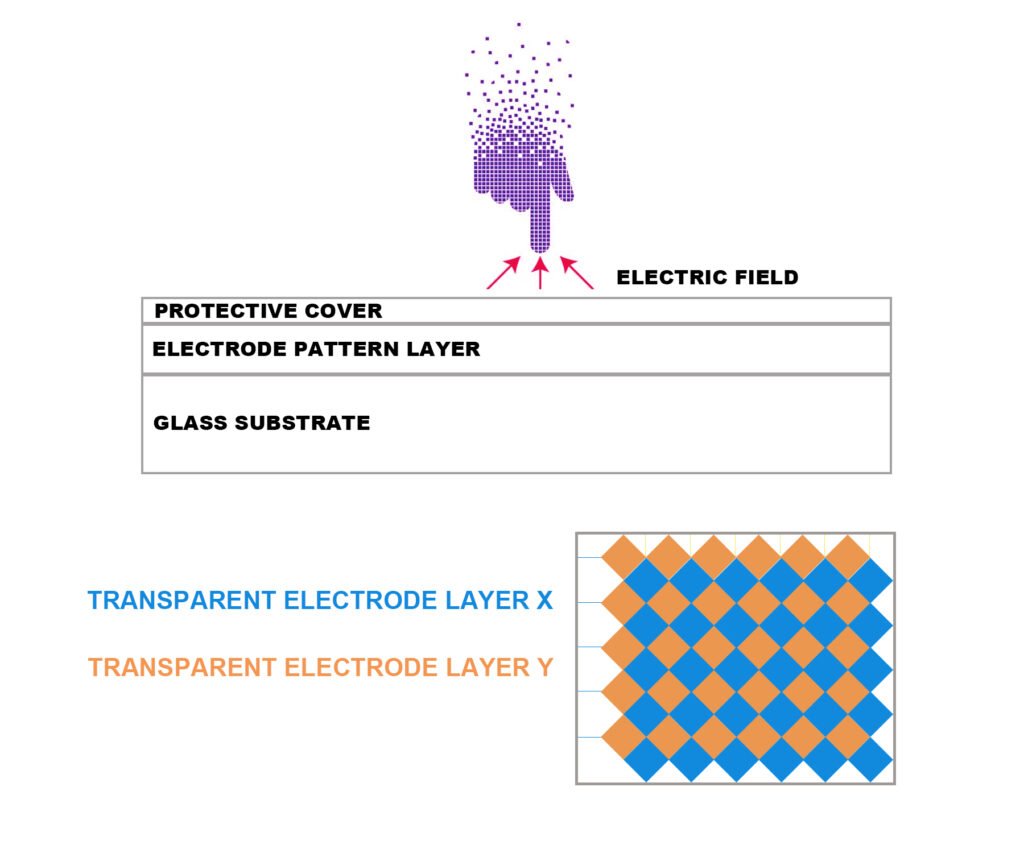
Sensor Layer: Patterned conductive electrodes form the sensing area. Depending on the design, electrodes may use materials such as indium tin oxide (ITO) or metal mesh on glass or film. The electrode layout and connection routing must match the selected controller.
Cover Lens: The cover lens forms the touch surface and protects the sensor. Its material, thickness and bonding stack influence mechanical performance and touch sensitivity. Review these properties with the sensor and controller.
Flexible Printed Circuit (FPC): The FPC carries electrical connections between the sensor and the touch controller. The controller may be mounted on the FPC or on a separate circuit board, depending on the design.
Touch Controller: The controller scans the sensor electrodes, processes capacitance measurements and reports touch coordinates to the host. Review the sensor, controller, cover lens and host interface as a matched configuration.
How Projected Capacitive Touch Sensing Works
A finger near the sensing surface changes the electric field and capacitance measured by the touch system. The controller repeatedly scans the electrode pattern, filters the measurements and calculates touch coordinates. Its ability to distinguish an intended touch from electrical noise or liquid effects depends on the sensor, controller firmware, cover lens, grounding and system integration.
PCAP Capabilities and Design Limits
PCAP can support the following capabilities when the touch stack and controller are selected and validated for the application:
- Multi-Touch Capability: Suitable sensor and controller combinations can track multiple contacts. Supported contact count and gesture handling depend on the selected touch system and host software.
- Mechanical Durability: A cover lens can provide a robust touch surface. Scratch and impact resistance depend on its material, thickness, support structure and validation; PCAP sensing alone does not establish a protection rating.
- Optical Integration: A transparent sensor layer allows the display to be viewed through the touch assembly. Optical quality depends on the electrode pattern, cover lens and bonding stack, so assess the complete assembly for the application.
For sensor layout, controller matching and FPC routing decisions, read our PCAP touch panel design guide. Validate the selected touch assembly in the final enclosure and electrical environment before approving it for production.
You can click the link to select suitable capacitive touch screen products: Capacitive Touch Panel Products.