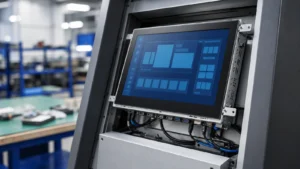
AG, AR and AF composite glass treatment is widely used in high-end touch displays to improve readability, reduce reflection, enhance touch feel and make the front glass easier to clean. For industrial HMI, automotive displays, outdoor terminals, medical equipment and premium commercial displays, the correct surface treatment process directly affects optical performance, user experience and long-term reliability.
Reference specifications now available: AG options include gloss 50 ± 10 with 6–15% haze or gloss 80 ± 10 with 2–7% haze; AR targets are ≥94% transmittance and ≤6% reflectance; AF targets are ≥110° initial water contact angle and ≥100° after the defined 1,500-stroke steel-wool test.
Discuss Your Cover Glass Requirement View Process OptionsWhat AG / AR / AF Composite Glass Means
In a touch display system, the cover glass is not only a protective layer. It also determines how the screen looks under ambient light, how smoothly the user can touch the surface, and how easily the front panel can be cleaned after long-term use.
AG, AR and AF are three different surface treatment technologies. AG reduces glare, AR reduces optical reflection, and AF reduces fingerprint adhesion. When combined properly, they can improve readability, visual comfort, touch feel and cleaning performance.
Engineering principle: AG, AR and AF should not be selected independently. The final structure must consider glass thickness, ink type, tempering process, coating stack, optical target, touch sensitivity and reliability requirements.Functions of AG, AR and AF Treatments
AG: Anti-Glare
AG treatment creates a controlled micro-texture or haze effect on the glass surface to diffuse ambient light and reduce harsh glare. It is useful for industrial control panels, outdoor terminals and bright indoor environments.
AR: Anti-Reflection
AR coating uses an optical film stack to reduce surface reflection and improve display clarity. In optimized designs, AR can improve contrast and transparency, especially under strong ambient light.
AF: Anti-Fingerprint
AF coating provides a hydrophobic and oleophobic surface that reduces fingerprint adhesion and improves touch sliding feel. It also helps make the glass easier to wipe and maintain.
Composite value: AG improves visual comfort, AR improves optical clarity, and AF improves user touch experience and cleaning performance.Process Routes for Different Ink Systems
The process sequence of cover glass production is strongly affected by the ink system. Low-temperature organic ink and high-temperature ceramic ink follow different production routes because they respond differently to the tempering process.
| Ink Type | Typical Process Route | Key Characteristics | Typical Applications |
|---|---|---|---|
| Low-Temperature Organic Ink | AG → Tempering → Silk Printing → AR → AF | Organic ink is usually printed after tempering because high temperature may damage the ink layer. AR and AF are applied later as functional coating layers. | Commercial displays, education devices, tablets, indoor terminals and cost-sensitive display products. |
| High-Temperature Ceramic Ink | AG → Silk Printing → Tempering → AR → AF | Ceramic ink can be printed before tempering and sintered during the tempering process. The ink layer bonds strongly with the glass surface after high-temperature treatment. | Automotive displays, industrial control devices, outdoor terminals and harsh-environment touch displays. |
Standard AG + AR + AF Composite Process Logic
For high-end touch display cover glass, a common functional sequence is AG first, then AR, then AF. This sequence helps build the optical and touch-feel performance layer by layer.
Step 1: AG Treatment
AG is used to reduce glare by creating controlled surface diffusion. For etched AG glass, the treatment is commonly completed before tempering to maintain process stability.
Step 2: AR Coating
AR coating is typically applied after tempering because the optical film stack may be affected by high-temperature glass tempering. The AR layer helps reduce reflection and improve clarity.
Step 3: AF Coating
AF is usually applied as the outermost functional layer. It reduces fingerprints, improves smooth touch feel and makes the front glass easier to clean.
Key rule: AR and AF are normally final functional coatings. They should be protected from unnecessary high-temperature processes, mechanical abrasion and chemical contamination.Typical Applications of AG / AR / AF Composite Glass
Industrial HMI
Improves readability under workshop lighting and reduces fingerprint contamination during repeated operation.
Outdoor Terminals
Helps reduce glare and reflection for kiosks, charging stations, ticketing systems and other semi-outdoor equipment.
Automotive Displays
Supports better sunlight readability, durable printed border design and improved user touch comfort.
Medical Devices
Supports cleaner operation, reduced glare and easier wiping for diagnostic and monitoring interfaces.
Commercial Displays
Improves visual presentation and user experience for interactive displays and high-end service terminals.
Education and Public Devices
Reduces glare and fingerprint buildup on frequently touched screens in shared environments.
Key Selection Parameters
| Parameter | What to Confirm | Why It Matters |
|---|---|---|
| AG Haze Level | Define the required haze level based on lighting condition and image clarity target. | Too much haze may reduce sharpness; too little haze may not sufficiently reduce glare. |
| AR Reflection Target | Confirm reflection requirement, wavelength range, measurement angle and coating stack. | AR performance depends on optical design and test condition, not only the coating name. |
| AF Contact Angle | Review water and oil contact angle, sliding feel and fingerprint resistance. | AF quality affects user touch comfort and cleaning performance. |
| Ink System | Choose low-temperature organic ink or high-temperature ceramic ink based on application and reliability target. | The ink system determines whether printing is done before or after tempering. |
| Coating Durability | Check abrasion resistance, chemical resistance, adhesion and environmental reliability. | Surface coatings must maintain performance after cleaning, wiping and long-term use. |
| Touch Compatibility | Verify touch sensitivity, glove operation, wet touch behavior and controller tuning after glass treatment. | Cover glass treatment should not create unstable touch response or sensitivity loss. |
Common Process Risks and Control Points
Excessive Haze After AG Treatment
If the AG surface is too rough, the screen may look grainy or less sharp. Haze level should be selected based on viewing distance and display resolution.
AR Film Durability Risk
AR coating must be evaluated for adhesion, abrasion, humidity and cleaning resistance. Poor AR durability may cause visible film defects or color shift.
AF Performance Decay
AF coating may lose performance after repeated wiping or chemical exposure. Contact angle and cleaning durability should be verified for the target application.
Ink and Coating Compatibility
Ink, tempering, AR coating and AF coating must be compatible. Otherwise, peeling, color change, poor adhesion or edge defects may occur.
Important: AG / AR / AF performance should be validated after the complete glass process, not evaluated only by individual coating samples.Ever Glory AG / AR / AF Composite Glass Solution
Ever Glory provides customized cover glass and touch display solutions for industrial, automotive, outdoor, medical and high-end commercial applications. For projects requiring AG, AR and AF composite treatment, our engineering team can review the complete structure, including cover glass thickness, silk printing ink, tempering route, optical coating stack, touch sensor design and final reliability validation.
Process Route Review
Select the proper sequence for AG, printing, tempering, AR and AF based on the selected ink system and reliability target.
Optical Performance Balance
Balance haze, reflection, transparency, contrast and surface feel according to the display environment and customer acceptance standard.
Touch and Reliability Validation
Verify touch sensitivity, coating adhesion, abrasion resistance, cleaning resistance and environmental stability before mass production.
Recommended approach: for harsh environments, high-temperature ceramic ink and durable coating validation should be considered. For indoor cost-sensitive applications, low-temperature ink may provide a more flexible and economical process route.Factory-Confirmed AG / AR / AF Reference Specifications and Test Methods
Quick answer: Ever Glory can currently quote two AG surface options, an AR optical target, an AF contact-angle target and defined abrasion conditions. These figures are more useful than treatment names alone because they give OEM buyers measurable values to place on drawings, RFQs and inspection documents.
Scope: The values below are factory- or supplier-confirmed reference specifications. The pencil-hardness result applies only to the tested sample identified below. Final acceptance criteria must be confirmed for the actual glass thickness, ink, coating stack, size and measurement method.
Available Reference Values
| Item | Reference Specification | Drawing / RFQ Note |
|---|---|---|
| AG option A Lower gloss / stronger diffusion | Gloss: 50 ± 10 Haze: 6–15% Fine-texture particle value: ≤0.16 µm | Suited to stronger glare reduction. Confirm gloss measurement geometry and the supplier’s particle/texture measurement method. |
| AG option B Higher gloss / lower haze | Gloss: 80 ± 10 Haze: 2–7% Fine-texture particle value: ≤0.15 µm | Suited to applications that prioritize image sharpness while retaining a light AG effect. Confirm the same measurement details. |
| AR-treated glass | Transmittance: ≥94% Reflectance: ≤6% | State the wavelength range, incident angle and whether one or both surfaces are coated before using these values as acceptance criteria. |
| Complete visible area | Visible-light transmittance: ≥85% as a general project requirement | Evaluate the finished viewing stack. Glass thickness, ink overlap, touch sensor, adhesive and display structure can change the final result. |
| AF surface | Initial water contact angle: ≥110° After abrasion: ≥100° | Use the steel-wool method below so the post-wear contact angle is reproducible and comparable. |
AF Steel-Wool Abrasion Method
- Load: 500 g
- Abrading head: 2 × 2 cm
- Abradant: #0000 steel wool
- Duration: 1,500 strokes
- Counting: one forward-and-return cycle equals two strokes
- Speed: 40–50 strokes per minute
- Acceptance: ≥110° initially and ≥100° after abrasion
This condition evaluates AF durability. It is not the same test as pencil hardness.
Recorded 7H Pencil-Hardness Result
Test report YLQC20231011002, dated October 11, 2023, records one 10.1-inch black-printed cover-glass sample, model 10.1-303.
- Pencil grade: 7H
- Load: 500 g
- Pencil-to-surface angle: 45°
- Travel distance: 3–5 cm
- Result: no scratch at the tested position; pass
Claim boundary: this is a sample-specific result and should not be presented as a universal 7H guarantee for every AG, AR or AF configuration.
Cleaning-Chemical Compatibility Test Matrix
The intended end-use cleaner should be included in project validation. A practical compatibility matrix may cover the following liquids:
| Category | Liquids to Evaluate | Important Control |
|---|---|---|
| Alcohol- and water-based cleaners | IPA, medical ethanol disinfectant, absolute ethanol, neutral glass cleaner, deionized water and saline | Define concentration, contact time, wiping material and number of cleaning cycles. |
| Food and beverages | Carbonated drinks, red wine, beer, fruit juice, coffee, tea, ketchup and edible oil | Check staining, residue, coating appearance and contact-angle change after cleaning. |
| Chlorine disinfectant | 84 disinfectant at 1:100 dilution | Low concentration and short wiping contact only; rinse or wipe according to the agreed procedure. |
| Organic solvents and fuels | Acetone, xylene, cleaning solvent (“white electric oil” / 白电油) and gasoline | These are aggressive media and require project-specific exposure limits and coating validation. |
| Oils and dressings | Silicone oil and automotive interior dressing oil | Check residue, optical appearance, touch feel and AF contact angle after removal. |
Do not treat this list as a blanket chemical-resistance claim. A pass/fail statement requires an agreed concentration, temperature, dwell time, wipe-cycle count, rinse method and acceptance criteria. For the finished part, recheck appearance, transmittance, coating adhesion and AF contact angle as applicable.
What OEM Buyers Should Put on the Drawing
- The selected AG option, including gloss, haze and texture value
- AR transmittance and reflectance together with the optical measurement conditions
- Finished visible-area transmittance target, if the complete stack must meet ≥85%
- AF initial and post-abrasion water contact angles
- The complete steel-wool test method: load, head size, grade, strokes and speed
- Pencil-hardness grade, load, angle, travel distance, test location and sampling quantity
- Application-specific cleaning chemicals and their exposure conditions
AG / AR / AF Composite Glass FAQ
Can AG, AR and AF be applied to the same cover glass?
Yes. AG, AR and AF can be combined, but the process sequence and coating compatibility must be controlled carefully. The final performance should be validated on the complete glass structure.Why is AF usually the final coating layer?
AF is designed to provide the final touch-feel and anti-fingerprint surface. If another process is applied after AF, the coating may lose smoothness, contact angle or contamination resistance.Is high-temperature ceramic ink better than low-temperature organic ink?
Ceramic ink usually offers stronger adhesion and better environmental durability, making it suitable for automotive, outdoor and industrial applications. Organic ink is more flexible and cost-effective for many indoor or consumer-oriented applications.Will AG treatment reduce display clarity?
AG treatment can reduce glare, but excessive haze may reduce perceived sharpness. The haze level should be selected based on the display resolution, viewing distance and lighting environment.Can Ever Glory customize AG / AR / AF glass for industrial touch displays?
Yes. Ever Glory can customize cover glass thickness, AG haze level, AR coating direction, AF surface performance, silk printing ink and touch display integration according to project requirements.What AG gloss and haze options are currently available?
Two factory-confirmed reference options are available: gloss 50 ± 10 with 6–15% haze and a fine-texture value of ≤0.16 µm, or gloss 80 ± 10 with 2–7% haze and a fine-texture value of ≤0.15 µm. The final drawing should also state the agreed measurement method.How is AF wear resistance evaluated?
A defined reference method uses a 500 g load, a 2 × 2 cm head and #0000 steel wool for 1,500 strokes at 40–50 strokes per minute. One forward-and-return cycle counts as two strokes. The water contact angle should be at least 110° initially and at least 100° after abrasion.Does the 7H report mean every AG / AR / AF glass is guaranteed to be 7H?
No. Report YLQC20231011002 records a passing 7H result for one specific 10.1-inch black-printed cover-glass sample tested with a 500 g load at 45°. Other glass, ink and coating combinations require their own validation.Need AG / AR / AF composite glass for your touch display project?
Share your application, display size, cover glass thickness, lighting environment, ink requirement, target surface treatment and reliability conditions. Ever Glory can help review the process route and recommend a suitable AG / AR / AF composite glass solution.
Contact Ever Glory View Touch Display ProductsEmail Us
admin@evergloryltd.com
Email Us
admin@evergloryltd.com
Email Us
admin@evergloryltd.com
Email Us
admin@evergloryltd.com