Direct answer
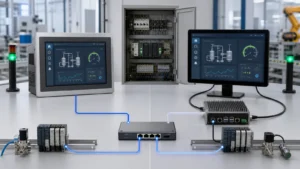
LVDS, eDP, MIPI DSI and HDMI describe different video connection boundaries; they do not guarantee compatibility by name. HDMI is usually a system-level video input, while LVDS, eDP and MIPI DSI are often embedded display links that depend on host, panel, power, connector, timing, firmware and cable details. Touch must be checked separately because PCAP touch commonly uses USB, I2C or serial communication.
Interface Compatibility Decision Table
| Interface | Typical System Boundary | Host Requirement | Main Compatibility Checks | Touch Interface | Best Starting Scenario | Main Integration Risk |
|---|---|---|---|---|---|---|
| HDMI | External or system-level video between host and monitor. | Host outputs a supported video signal to the display input. | Input type, timing, connector access, cable route and enclosure fit. | Separate USB, I2C or serial touch path. | Industrial monitor or open frame monitor connected to an IPC. | Assuming video compatibility also confirms touch compatibility. |
| LVDS | Embedded LCD link between panel and driver board or host board. | Host or controller board must match the exact LCD panel requirement. | Panel-specific pinout, resolution, timing, channel mapping, panel power, cable and controller support. | Separate controller and host communication path. | Custom embedded LCD integration with a known panel model. | Treating one LVDS panel as interchangeable with another. |
| eDP | Modern embedded display link inside a device or display module. | Host must support the selected panel link behavior and power sequence. | Lane/link settings, AUX and HPD where applicable, connector, power sequence and panel compatibility. | Separate USB, I2C or serial touch path. | New embedded display design with a controlled panel and host board. | Assuming eDP panels are interchangeable without firmware and power review. |
| MIPI DSI | Host-specific embedded display link for selected platforms. | Host board and firmware/BSP must support the selected display implementation. | Lane count, initialization, timing, connector, pinout, power sequence and firmware/BSP support. | Separate touch-controller interface. | Embedded host design where the display and host are selected together. | Assuming one host supports every display with the same interface name. |
HDMI for External or System-Level Video Connections
HDMI is normally reviewed as a system-level video path. The host outputs video, the monitor receives video, and touch travels separately through the selected touch interface. An HDMI connector alone does not define PCAP touch behavior.
LVDS for Embedded Industrial LCD Integration
LVDS review starts with the exact LCD panel. Check panel-specific pinout, resolution, timing, channel mapping, panel power, cable design and controller-board compatibility. Interface name alone does not make two panels interchangeable.
eDP for Modern Embedded Displays
eDP review depends on the selected panel and host board. Check lane or link settings, AUX and HPD behavior where applicable, power sequence, connector, cable and firmware support. It should not be treated as a universal drop-in connection.
MIPI DSI for Host-Specific Embedded Displays
MIPI DSI is often implementation-specific.
A host board that supports MIPI DSI is not automatically compatible with every MIPI DSI display. Lane count, host support, initialization, timing, firmware/BSP, connector, pinout and power sequence must be reviewed for the exact configuration.
Video Interface vs Touch Interface
Video and touch should be checked as two paths. A display can show an image while touch fails, and touch can enumerate while video fails. Review the display interface together with the touch controller, cable, grounding and host driver expectations.
How This Affects Product Selection
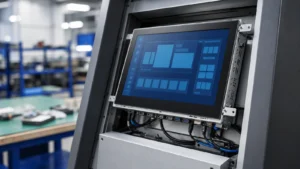
An open frame touch screen monitor often simplifies integration by using external video and USB touch. A touch display module may require deeper panel, board and cable coordination. A panel PC moves the host platform into the operator station and changes the interface review.
If touch behavior is unstable after integration, compare the interface review with the PCAP controller troubleshooting guide, especially around grounding, FPC routing and host changes.
Host and Panel Compatibility Checklist
- Do not approve a display only from the interface name.
- Separate the video-interface review from the touch-interface review in the RFQ.
- Confirm USB/controller pin definitions before changing cables.
- Route FPC and controller cables away from high-frequency signal paths and host power areas.
- Review LCD board, touch controller and metal frame grounding as one system.
- Run Sensor Test after host board, mainboard or touch controller changes.
- Lock the approved panel, board, cable and firmware combination before repeated production.
Related engineering resources
Source and evidence boundary
This guide is supported by EverGlory installation material covering controller board wiring caution, FPC routing, LCD board and touch controller grounding, Sensor Test after host changes and whole-system tuning. Controller-level touch interfaces must be checked by exact solution, not by interface name alone.
This guide does not turn a project requirement, interface name or component capability into a universal product claim. Certification, protection rating, environmental limits, lifecycle and availability must be confirmed against the selected configuration and evidence package.
Frequently asked questions
Does HDMI compatibility mean touch will work?
No. HDMI carries video. Touch usually uses a separate USB, I2C or serial connection, so the touch controller and host driver still need to be reviewed.
Does LVDS or eDP mean any panel can connect?
No. Panel model, timing, voltage, connector, pinout, cable and driver-board firmware must match. Interface name is only the starting point.
Is a same-name embedded display interface guaranteed to work?
No. Compatibility depends on the selected configuration, host support, display implementation, firmware and power design. It must be reviewed for the exact project.
Why mention touch interface separately?
Because touch data is generated by the touch controller, not by the display video interface. The two paths can pass or fail independently.
What should be included in an interface RFQ?
Send the LCD model if fixed, host board, desired resolution, video interface, touch controller preference, USB/I2C/serial requirement, cable length, connector direction and mechanical drawing.
Can interface changes affect touch noise?
Yes. Host board changes, grounding changes, power routing, metal frame interference and cable/FPC movement can affect PCAP behavior even when the display signal works.
Send the interface package for review
Share the host board, target display panel, video interface, touch interface, connector drawing, cable length, mounting structure and operating system. EverGlory can review the display and touch paths separately.