
Validation Evidence for Industrial Touch Displays
Test conditions, applicable products, acceptance criteria and records must be linked to a defined product configuration. Capability statements are kept separate from verified third-party reports.
Test capability categories
The exact plan is agreed according to the product level, intended environment and customer acceptance requirements.
Touch Function
- Sensor functional check before assembly and shipment
- Touch tracking, interface and controller verification
- Wet-touch or glove scenarios when conditions are defined
- Installed-system retest after mechanical integration
Environmental
- High- and low-temperature capability
- Temperature-change and humidity capability
- UV-weathering capability for relevant materials
- Project-specific duration and sample plan
EMC Engineering
- ESD pre-check where specified
- Grounding and cable/FPC routing review
- Controller and display signal checks
- Third-party EMC documentation for covered scopes
Mechanical and Material
- FPC, cable and bonding-force checks where specified
- Microscope inspection of sensor, FPC and bonding areas
- Cover-glass stress and stress-depth measurement capability
- Water contact-angle measurement capability
Optical and Appearance
- Appearance inspection and defect documentation
- Visible, UV and IR spectrum testing through third-party scope
- Viewing-area and bonding-quality inspection
- Result records tied to the tested sample
Aging and Protection
- PCB or system burn-in when included in the control plan
- Front-panel sealing concept review
- IP verification only for the exact tested assembly and report scope
- Ongoing and final inspection records where agreed
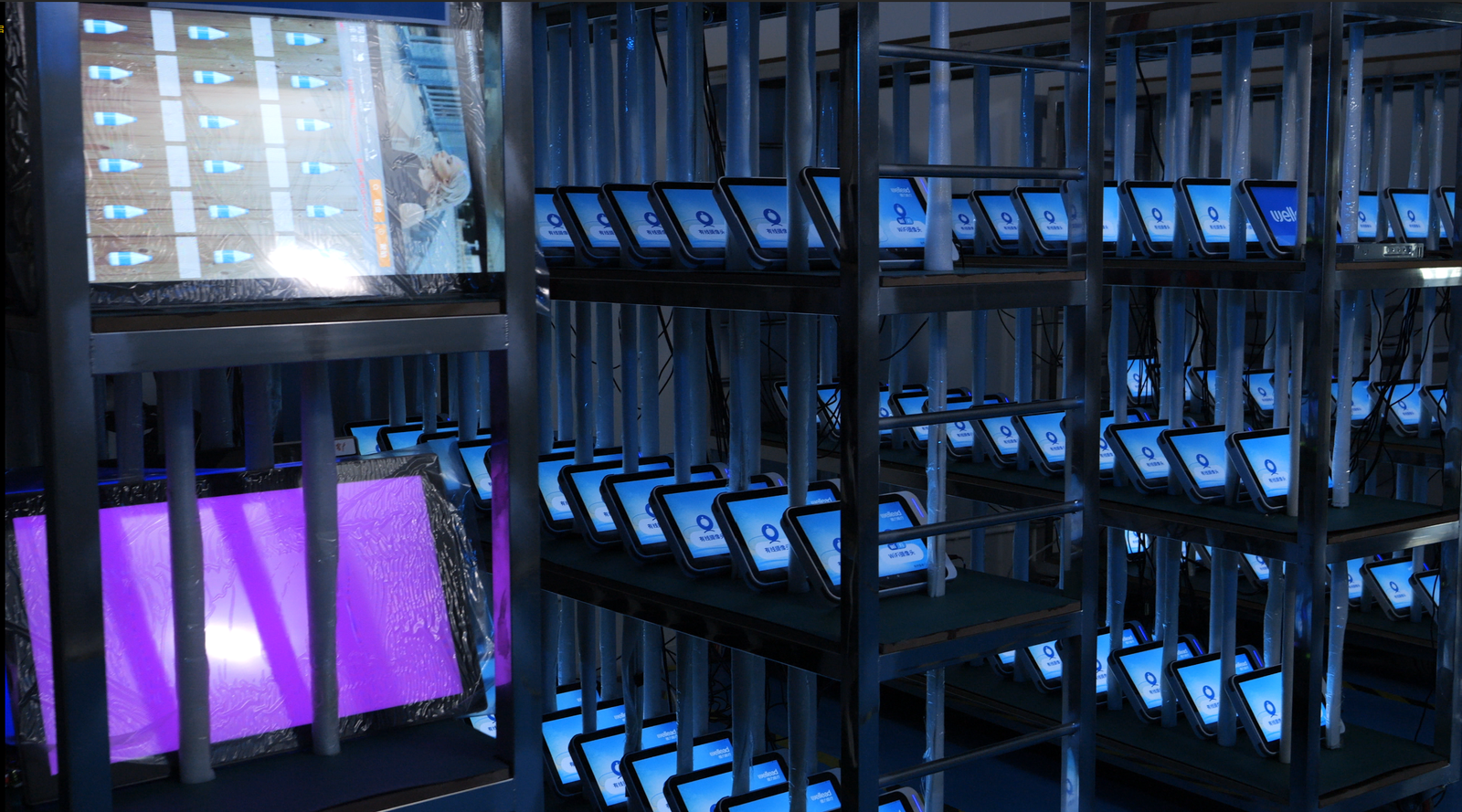
Powered aging and burn-in screening
Multiple display units can be powered and observed on controlled racks to support project-defined burn-in or aging checks. The applicable product configuration, duration, checkpoints and acceptance criteria are confirmed in the project control plan.
Evidence boundary: the room and equipment show available capability. A pass statement still requires the completed record for the applicable unit or batch.
ESD engineering verification before formal compliance testing
ESD behavior can be checked on a defined touch-display sample while the engineer records the product revision, power state, discharge mode, contact points and observed touch or display behavior.
Evidence boundary: the video demonstrates internal engineering verification capability. It does not state a voltage level, standard compliance or pass result without the corresponding test record.
Video content index and recording information
- 00:00–00:10 — ESD simulator, powered sample and engineering setup.
- 00:10–00:29 — Discharge application around the defined touch-display assembly.
- 00:29–00:41 — Display operation and touch-response observation after the engineering check.
Text alternative: an engineer uses an ESD simulator on a powered industrial touch display and then checks display operation and touch response. The scene is internal engineering evidence and does not state certification or a pass result without the matching record.
Internal checks and third-party reports are not the same
| Evidence type | What it demonstrates | How it may be used |
|---|---|---|
| Engineering capability | Available equipment, review method or ability to run a defined check. | Describe the capability; do not state a product passed without a test record. |
| Internal test record | A defined sample or batch was checked against an approved plan. | Quote the result only with the condition, acceptance limit, record ID and product revision. |
| Third-party report | The tested sample/model was evaluated to the standards and setup stated in the report. | Use only within the covered sample, model, configuration and report scope. |
| Management-system certificate | The certified management-system scope and validity stated by the issuer. | Do not describe it as a product certification. |
Specification-defined validation example
A controlled 15.6-inch PCAP touch display specification provides concrete engineering targets for one documented reference configuration. These items show how validation is defined; they are not presented as a third-party certificate or a blanket pass claim for every model.
Touch acceptance targets
- 10-point projected-capacitive touch
- ≥100 Hz touch report rate
- ≤25 ms touch response time
- ±2 mm touch linearity
Optical and material targets
- >85% touch-panel transmittance
- ≥6H cover-glass surface hardness
- ≥4B ink-adhesion requirement
- 500 cd/m² typical LCD luminance
Mechanical verification items
- ≥800 gf/cm FPC pull requirement
- Impact-resistance criterion linked to cover thickness
- Drawing-based dimensional and stack-up inspection
- Appearance inspection after full optical bonding
Reliability and ESD definition
- High- and low-temperature storage items
- Temperature/humidity and 24-cycle thermal-shock items
- 8 kV contact-discharge ESD check
- 15 kV air-discharge ESD check
Evidence boundary: the controlled specification defines requirements and verification methods for the reference configuration. A pass statement requires the corresponding completed record, sample revision and result.
Verified third-party documentation examples
The following records have been checked against their applicant, sample, test conditions, result and document scope. Public release remains subject to document control and any reproduction restrictions stated by the laboratory.
Touch Monitor FCC Part 15B Class A
Report 2502Z30476E-00
Conducted and radiated emissions: Compliant
Tested model: YL-133MT1C-V1. Multiple-model coverage is limited to the electrically identical families defined in the report.
Powered Rapid Temperature Change
Report S20120704601E
Three 8-inch optically bonded modules: Pass
Powered and connected to a computer; -40°C to 70°C, 5°C/minute, 20 cycles. A controlled copy is supplied only after confirming the applicable model scope and document-release permission.
UV and Solar Optical Measurement
Report WT2023E09B00704EG1
Measured by a national glass test center
One anti-infrared and anti-ultraviolet touch-screen sample measured 77.0% visible-light transmittance and 4.8% UV transmittance. No pass threshold was stated.
PCAP CE EMC
Report 2502T60408E-01
Verified in the report register
Applicable only within the capacitive-touch-screen report scope.
Touch Display Module CE EMC
Report 2502T60410E-01
Verified in the report register
Applicable only to the items and configuration covered by the report.
Optical-Adhesive UV Aging Data
500-hour supplier material report
No debonding, bubbles or visible color change recorded
This evidence applies to the tested SCA-G optical-adhesive/glass sample and is not a finished-product certification.
Important: an optional feature, supplier component record, laboratory capability or reference standard is not a product certification. Environmental, optical and EMC results are published only with the matching sample, conditions, result and model scope.
Send the target model, interface and application environment for a scope check.
Current management-system certification evidence
| System | Certified activity scope | Current document status |
|---|---|---|
| IATF 16949:2016 | Design and manufacture of capacitive touch screens. | Certificate T181723 / IATF 0487672; valid through November 6, 2026. Request the current certificate or confirmed recertification status during supplier approval. |
| ISO 9001:2015 | R&D, production and sales of capacitive touch screens; production and sales of glass cover plates. | Certificate 69125Q00083R1M; valid through May 18, 2028. |
| ISO 14001:2015 | Environmental-management activities associated with the certified touch-screen and cover-glass operations. | Certificate 69126E00014R100; valid through February 2, 2029. |
Certification boundary: these are management-system certificates. They do not certify every product model, performance rating or environmental limit.
Quality gates from sample to shipment
Prototype record
Identify the sample revision, build configuration and validation plan.
Issue closure
Record nonconformities, engineering actions and the approved disposition.
First-article release
Confirm the released drawing, key inspection items and production baseline.
In-process control
Apply inspection checkpoints defined by the product control plan.
Outgoing inspection
Verify the released batch against agreed functional, appearance and packaging criteria.
Traceability
Retain the revision and batch information agreed for the delivery package.
Related resource: see how these gates connect to production quality and traceability controls.
Related resources: see our engineering capabilities and OEM/ODM manufacturing workflow.
Frequently asked questions
Does a listed test capability mean every model has passed that test?
No. A capability means the method or equipment can be available. A product result must be supported by a record tied to the tested model, revision, conditions and acceptance criteria.
Can you provide third-party reports?
Report summaries or controlled copies may be provided after confirming the requested product and whether it is covered by the report scope.
How should an IP65 or IP67 claim be validated?
The complete front-panel assembly, mounting and sealing configuration must be tested under the applicable method. The rating should not be extended to a different housing, mounting method or product revision without evidence.
Request the relevant evidence package
Tell us the target product, application environment and required standard. We will identify which internal records or third-party reports are relevant to that configuration.
Verified evidence register · reviewed 9 September 2026
Tested sample, conditions and result—kept together
The register below includes only records for which the sample, condition and conclusion can be stated without extending the result to unrelated models.
| Record | Tested scope | Conditions or standard | Recorded result | Use boundary |
|---|---|---|---|---|
| 2502Z30476E-00 Touch monitor FCC 27 Nov 2025 | YL-133MT1C-V1 and the electrically identical families defined in the report | FCC Part 15B; ANSI C63.4-2014 | Conducted and radiated emissions compliant | Tested family only |
| S20120704601E Rapid temperature change 15 Dec 2020 | Three 8-inch optically bonded touch-display modules | Powered and connected; −40°C / 30 min to +70°C / 30 min; 5°C/min; 20 cycles | Pass for the three tested samples | Configuration-specific |
| WT2023E09B00704EG1 UV/IR optical measurement 27 Nov 2023 | One 259 × 202 × 3.7 mm touch-screen sample | Visible and UV spectral measurement | Visible transmittance 77.0%; UV transmittance 4.8%; no pass threshold stated | Measured values |
| UVA-340 material-stack record 500-hour aging | Glass–SCA–glass optical material stack | 500 hours of UVA-340 exposure | No delamination, bubbles or recorded color change | Material stack only |
| 2502S52794E-SF IK11 impact 14 Apr 2025 | EG-31.5-231-1609V1 touch-screen monitor | IEC 62262:2002 + AMD1:2021; 50 J procedure | Appearance pass after the procedure for the tested sample | Tested model only |
| Factory-recorded ESD verification Sep 2026 | Powered touch-display engineering sample shown on this page | Internal engineering verification scene | Demonstrates test capability; no compliance level or pass claim is inferred | Internal evidence |
Release rule: full third-party reports remain controlled. Procurement receives the applicable record only after model, revision, electrical configuration, destination market and document-release conditions are checked.
Related evidence
Use test evidence with the correct product scope
Testing records become procurement evidence only when the sample, configuration, condition and result match the quoted product.
Compliance evidence
Check report identifiers, dates and applicability boundaries.
OEM and ODM workflow
Build validation gates into the sample and release plan.
Production traceability
Connect the approved configuration to first article, in-process and outgoing records.