Direct answer
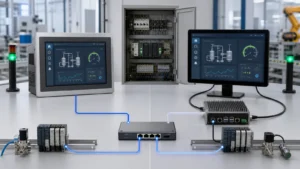
An industrial HMI replacement should begin by separating software runtime, PLC communication and operator display hardware. A same-model spare may be simplest when available. A compatible migration may be needed when the original platform is obsolete. A panel PC or touch monitor can modernize the operator station, but a touch monitor only replaces display and touch hardware; it does not directly replace PLC HMI software.
Why Industrial HMIs Need Replacement
Replacement projects usually begin when an older HMI is discontinued, spare parts are unavailable, display or touch hardware fails, replacement lead time is too long, the operating environment has changed, or the machine builder wants to reduce lifecycle risk. Each case should be reviewed against the actual hardware, software and cabinet constraints.
Three HMI Replacement Paths
| Path | Best when | Main risk |
|---|---|---|
| Same-Model Replacement | The original hardware and project remain available. | Future availability remains unchanged. |
| Compatible HMI Migration | The PLC/HMI ecosystem supports migration. | Project conversion, drivers, tags and runtime compatibility. |
| Panel PC or Touch Monitor Modernization | The system architecture can separate or modernize computing and display. | Software, interfaces, mounting and system validation. |
Hardware Price vs Total Migration Cost
A lower-cost panel does not automatically mean a lower project cost. The real migration scope may include project files, PLC communication, drivers, runtime environment, tags, alarms, recipes, historian links, licenses, validation and operator retraining where applicable. Hardware should be selected after the migration scope is understood.
HMI Spare-Part and Lifecycle Planning
For repeat machines, define an approved configuration, drawings, model-control record, spare-unit strategy, revision-control method, replacement path and supplier-change notification expectation. These controls reduce surprise substitutions without creating unsupported availability promises.
Engineering Checklist
- Confirm whether the old HMI hosts the software runtime or only acts as display and touch hardware.
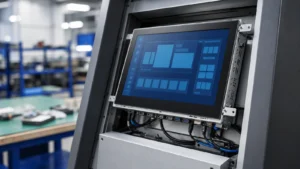
- Record old model, cutout, view area, active area, mounting holes, cable exit and rear-depth limits.
- Separate display signal from touch communication before choosing a replacement screen.
- Review USB, I2C or serial touch-controller behavior against the selected host.
- Check grounding, metal-frame interference, FPC routing and water accumulation risk.
- Run Sensor Test after host, mainboard, controller or cable-route changes.
- Define replacement acceptance tests before releasing repeated production.
Replacement Fit Notes
If the cabinet opening is fixed, compare the project with the panel mount vs open frame touch monitor guide. For browser-based modernization, use the Web HMI hardware guide. For interface uncertainty, use the industrial display interface guide.
Choose a touch panel PC when local computing belongs in the operator station. Choose an open frame touch screen monitor when another host keeps the software runtime and only display/touch hardware needs replacement.
Related engineering resources
Source and evidence boundary
This guide uses first-party installation evidence around grounding, TP/LCD integration, FPC routing, USB/controller pin caution, Sensor Test after host or mainboard changes, water-related false touch and whole-system tuning before mass production. It does not claim that a touch monitor replaces PLC HMI software or the compliance assessment for machine safety functions.
This guide does not turn a project requirement, interface name or component capability into a universal product claim. Certification, protection rating, environmental limits, lifecycle and availability must be confirmed against the selected configuration and evidence package.
Frequently asked questions
Can an industrial touch monitor replace an old HMI?
It can replace display and touch-input hardware when the existing host still provides the HMI software and compatible signals. It does not replace PLC logic or HMI software by itself.
When should I choose a panel PC for HMI replacement?
Choose a panel PC when the old terminal contained computing hardware or when the new design needs the browser client, operating system, local files and application deployment at the operator station.
What drawings are needed before a sample?
Provide the old cutout, view area, active area, outer dimensions, mounting-hole position, front-bezel structure, cable exit direction and rear-space restrictions.
Why can a same-size screen still fail to fit?
Screen diagonal does not define outer structure. Active area, cover glass, bracket position, connector direction and enclosure thickness must be checked.
Can old touch problems come from the machine instead of the panel?
Yes. Grounding, metal frame interference, FPC movement, high-frequency signals, power routing or water accumulation can create touch instability.
How are safety buttons handled in a replacement?
Emergency-stop and enabling-switch functions must remain in the final machine safety architecture and compliance assessment. They should not be treated as ordinary display accessories.
Send the old HMI replacement details
Include photos, drawings, current signal interface, touch connection, host information, cutout size, mounting method and software responsibility. EverGlory can review whether a panel PC or touch monitor path is suitable.