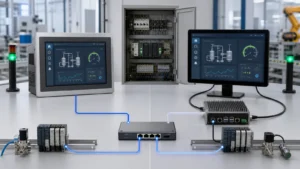

Choose a sunlight readable display by matching the product format to your equipment, then confirming the installed optical, touch and thermal configuration. A module needs your housing and integration; a monitor provides a display assembly; a panel PC also includes computing hardware. A higher nit rating alone does not settle that choice.
Use this guide to produce a supplier shortlist with a defined configuration, comparable brightness measurements and a sample acceptance plan. The copyable RFQ template keeps project inputs, supplier answers, evidence and unresolved items together.
Start with the product format your team can integrate
| Evaluate this format | When your project needs | Confirm before shortlisting |
|---|---|---|
| Touch display module | A display and touch assembly for your own housing and host | Included controller boards, optical stack, mounting support and who owns sealing |
| Sunlight readable monitor | A display assembly to connect to an existing host | Video and touch interfaces, power input, mounting drawing and protection scope |
| Panel PC | Display, touch and computing in one assembly | Computing platform, software support, combined heat load and available configuration |
These are procurement categories; confirm the actual supplied parts and availability. Request the configuration drawing, finished-assembly brightness conditions and applicable sample records for each shortlisted item.
1. Define where and how people will use the screen
“Outdoor” is too broad for a display specification. Record whether sunlight reaches the front surface, how long it remains exposed, and whether a canopy or surrounding building provides shade. A shaded terminal can still face bright reflected sky or a sunlit wall.
Define user height, viewing distance, screen orientation and operating hours. Check seated and standing viewing positions where relevant. Large text, clear buttons and adequate foreground contrast also affect usability; evaluate the actual interface rather than a promotional image.
Record ambient temperature, moisture, dust and cleaning agents alongside the light exposure. Include site photographs from relevant times of day and measured illuminance at the screen position when available. A location description helps identify test conditions; it does not replace testing the display there.
2. Select brightness together with reflection control
A nit measures luminance, but the rating alone does not describe what a user sees outdoors. Confirm whether the quoted value is measured on the bare LCD or through the finished touch and cover assembly. Ask about sustained output, dimming and behavior at the intended operating temperature.
Use our guide to how many nits a screen needs in sunlight for the brightness decision. Avoid choosing a panel solely because its nominal rating is higher than another panel tested under different conditions.
External and internal reflections can obscure dark interface areas. Optical bonding addresses reflections at bonded internal interfaces; surface treatments address different problems at the cover glass. Our optical bonding, AG, AR and AF guide explains which combination to evaluate.
Compare display technologies against the application
Evaluate a transmissive high brightness LCD when the interface requires backlit color content across day and night. If power consumption in bright ambient light drives the design, also investigate reflective or transflective options and compare color, contrast and low-light operation. Confirm availability and suitability with the supplier.
3. Specify touch, interfaces and mechanical integration
For PCAP touch, state the cover thickness, glove material and expected water exposure. Wet touch and glove touch depend on the sensor, controller, firmware and final installation. Increasing sensitivity may introduce unwanted inputs, so test the intended interactions and false-touch rejection together.
Freeze the mechanical drawing before approving the sample. Review visible area, bezel clearance, mounting pressure, gasket compression, connector access and FPC routing. Specify video and touch interfaces separately, including connector pin definitions, host compatibility and cable length.
For a terminal project, the outdoor kiosk and EV charging display guide connects these choices to enclosure, cabling and public-use requirements.
4. Review sealing, heat and serviceability as one system
Sunlight readability does not establish a waterproof rating. Ask whether a stated ingress rating applies to the front, complete monitor or final installed equipment. The rear connectors, gasket interface and enclosure openings need their own design review.
Likewise, ambient operating temperature and LCD surface temperature are different measurements. Solar exposure, a dark enclosure and electronics can raise internal temperatures. Evaluate the panel, backlight, controller and bonding materials within the completed enclosure, including any automatic brightness reduction.
Plan night-time dimming and the behavior of an ambient light sensor. Avoid a control loop that repeatedly brightens and dims when people shade the sensor. Agree on startup brightness, fault behavior and whether the host can override the setting.
Service access also matters. Decide whether maintenance replaces the complete monitor or individual assemblies, and confirm spare-part availability, revision control and replacement procedures before volume purchasing.
5. Validate a sample in the intended assembly
Set pass criteria before testing so purchasing and engineering compare the same evidence. A bench sample without the production cover glass, enclosure or host may miss the problem that appears in the field.
- Readability: evaluate real text and controls in representative shade and direct light, at expected viewing angles and with polarized eyewear if relevant.
- Thermal behavior: run the intended workload and brightness; record ambient, enclosure and relevant component temperatures and any dimming.
- Touch: check edges, drag paths and critical controls with the specified gloves and moisture conditions; include unintended-input checks.
- Integration: repeat touch checks with the actual power supply, host, cable routing and grounding arrangement.
- Durability: agree on environmental and cleaning tests appropriate to the project, then inspect optical quality and function afterward.
Keep the approved configuration, firmware, drawings and acceptance criteria with the sample record. A material or controller change should trigger a review of affected tests.
Use the outdoor environmental evidence and bonding process controls to identify relevant records and questions for the supplier.
Copy this outdoor display RFQ template
Copy the template into your enquiry. Keep unknown fields as “To complete”; ask the supplier to answer them explicitly. Compare suppliers against the same inputs and agree on acceptance criteria before ordering the sample.
PROJECT INPUTS
Application, location and intended users: To complete
Product format, screen size and project quantity: To complete
Sun exposure, orientation, shade and site photos: To complete
Viewing distance, interface content and operating hours: To complete
Ambient temperature, moisture, dust and cleaning agents: To complete
Cover/window construction and mounting drawing: To complete
Gloves, wet-surface use and critical touch actions: To complete
Host, video/touch interfaces, power and cable routing: To complete

SUPPLIER CONFIRMATION
Proposed model, included parts and drawing revision: To complete
Optical stack, touch controller and firmware: To complete
Brightness measurement surface, conditions and sustained output: To complete
Thermal limits, dimming behavior and protection scope: To complete
Service method, change control and sample availability: To complete

EVIDENCE AND SAMPLE ACCEPTANCE
Datasheets/drawings and applicable sample/report identifiers: To complete
Readability and touch tasks, conditions and pass criteria: To complete
Thermal, cleaning and environmental checks to agree: To complete
Test record, responsible reviewer and approval status: To complete

UNRESOLVED ITEMS
Missing information or mismatch: To complete
Responsible party and next action: To complete
What must be resolved before sample approval: To complete
Frequently asked procurement questions
What is the best monitor for outdoor use?
Choose the monitor that meets your installation’s readability, temperature, protection, touch and interface requirements. Compare complete assemblies under representative conditions; the highest nit rating alone does not identify the best fit.
Is a high brightness monitor automatically suitable for outdoor use?
No. Brightness is one requirement. The installed assembly must also meet the project’s reflection, temperature, moisture, touch and mechanical requirements.
Should I specify optical bonding for every outdoor display?
Evaluate it when internal reflection or the optical air gap is a concern. Compare the readability benefit with material suitability, assembly stress, serviceability and cost for the actual design.
Can I compare suppliers using only their nit ratings?
Only after confirming comparable measurement conditions. Ask where brightness is measured, whether it is sustained, and which cover, touch and dimming configuration is included.
What should I send for an initial display recommendation?
Send the completed RFQ template with the application, product format, screen size, site exposure, cover construction, touch requirements, interfaces, mounting drawing and project quantity. Leave unknowns marked “To complete” so the supplier can identify the missing inputs.
Sources and applicability
- Report S20120704601E, identified in the EverGlory test-record register. Three 8-inch optically bonded modules under defined powered temperature-change conditions; the report result is limited to those samples.
- EverGlory controlled production evidence. Identifies touch-panel and optical-bonding control plans. Completed sample or batch records are distinct from the control plans.
- EverGlory outdoor environmental evidence. Summarizes environmental and optical record applicability for outdoor project review.
For a model specification or source-document clarification, contact EverGlory with the model or record identifier.
Turn your outdoor requirements into a display specification
Compare sunlight readable display options when you are ready to shortlist hardware. To clarify the configuration first, send EverGlory your completed RFQ template, including unresolved items, for discussion of the display, touch and integration choices.